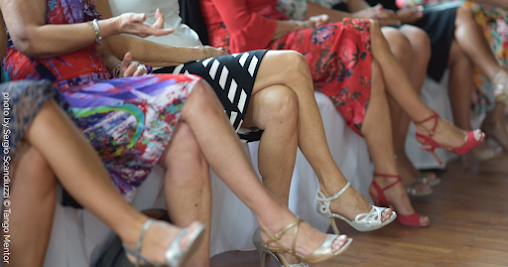
Want to be able to dance confidently and feel comfortable in traditional milongas of Buenos Aires?
Our teaching develops your musicality, connection, technique & improvisation with social tango, as well as insights into tango culture and critical skills to build your confidence with milonga etiquette.


Showing posts with label codigos. Show all posts

Sunday, 4 January 2026

The milonga jungle

 It's quiz time, folks!

Let's face it.  The tango world is full of characters: amusing, a few annoying and some delightful.  Sounds like life, right?

I know it may be painful, but just try thinking about those milonga situations that you would rather forget, with characters who have left you a little powerless or speechless at times.  Remember: Being forewarned is being forearmed.  You can even practise your response.  You CAN take control!

Here are a few real-life scenarios.  What would you do? (More than one response is possible)

  1. The Space Invader
    Two people are deep in conversation.  Their body-language shows that they are focussing on each other.  Someone approaches clearly indicating he/she wants to dance with one of them.
    a.  Ignore the person until he/she goes away
    b.  Acknowledge the person, and continue the conversation
    c.  Interrupt the conversation immediately and get up to dance
    d.  Acknowledge the person, point out that you are involved in a conversation and decline the invitation

  2. The Know-all
    While dancing, once dancer persists in telling his/her partner what they are doing wrong and correcting them.
    a.  Ignore him/her and continue dancing
    b.  Say that you can't dance and talk at the same time
    c.  Say "Thank you" and go right back to your seat making a mental note never to dance with that person again
    d.  Do your best to follow the generous advice

  3. The Human Shield
    After a tanda, rather that clearing the dance-floordurin ghte cortina, some people stand around on the floor chatting.  They are blocking the line of sight of seated dancers who will want to look for a new partner for the next tanda.
    a.  You feel frustrated that you can't see the person you'd like to dance with
    b.  If the "Human Shields" are close to you, ask them to move away or sit down
    c.  The DJ should extend the length of the cortina until they get the message and clear the floor

    How would you respond to these milonga characters?
    Can you think of others?
    PP
    Thanks to Kris Tengo Teng for the image  https://www.facebook.com/groups/147208172635874/user/405922/

Wednesday, 2 April 2025

Why do we say YES when we mean NO?

Have you been in the situation where you were invited to dance, but for some reason, preferred not to accept that invitation?  Even if this never happens to you, you may still want to keep reading.

Some dancers have described to me situations where they would’ve liked to refuse (or postpone) the invitation, but feared hurting the person’s feelings.  Some have confided feeling pressured to dance, but were unsure how to respond.  Some experienced dancers (often popular male dancers outnumbered by ladies) may be frequently approached directly for a dance - particularly in milongas where the cabeceo is not the norm.  Some of these people have said to me that they feel obliged to spread themselves around throughout the milonga.  Community-spirit is to be applauded - up to a point.  


It almost goes without saying that there are many reasons for not wanting to dance at times.  You may be involved in a conversation; may be feeling too hot after an energetic tanda; the music isn’t to your taste; you don’t feel comfortable with the inviter; just feel like listening to the music and watching the dancers; you had already arranged to dance with someone else; etc, etc.


Of course, “Yes” is always an option, but it may come at a price.  Are you finding yourself denied a chance to dance with many of the partners that you prefer?  When you dance, are you able to give your partner your all for that tanda, or are you just going through the motions?  Are you mostly satisfying the needs and desires of others, while ignoring your own?


Indeed, saying “No” carries the risk of offending the other person.  Perhaps you fear that the risk is just too great. So rather than working out a way of being true to yourself, you may take the path of least resistance and always say “Yes”.


What are some alternatives?  Apart, from a blunt “No”? 
Unfortunately, not everyone in your tango community uses the more subtle cabeceo.  And you don’t want to develop a reputation as unfriendly.


Have you tried …

-  engaging the person in a conversation, rather than getting up to dance?  It shows them that you’re still interested in them as a person.  If they don’t wish to chat, they can move on.
-  indicating non-verbally “maybe later” with a smile?
-  briefly mentioning the reason for not wanting to dance now, perhaps adding that you’ll look across at them later?

Maybe you have other successful strategies which you’d like to share.


On the other hand, if the person won’t accept your response, then you always have the blunt option of “No, thanks”!  After all, if someone asks a question, they cannot assume that the answer will always be the one they want to hear.  Why should the milonga be any different to other aspects of life?  


Tangomentor’s discussion makes further interesting reading on this subject


Turning down an invitation may appear difficult at first.  But when you’ve tried it once or twice, I’m sure you’d get the hang of it.  Better still, adopting the mirada + cabeceo in your community would render this problem redundant!
PP


Monday, 15 April 2024

Every little bit counts

After more than a week of dancing in traditional Buenos Aires milongas, I’m reminded of some of the social niceties which contribute to a harmonious dance floor as well as an enjoyable individual experience.  (Not a word about cabeceo here.  That topic has already had plenty of coverage.)

Each and every dancer makes a positive contribution to the milonga by:

* taking care of personal hygiene beforehand & avoiding strong scents

* changing into dance shoes in the bathrooms or away from the dance floor 

* when not dancing, ensuring that they aren’t blocking others’ line of sight. If standing to catch someone’s eye, then stand behind the tables

* entering the dance floor with care, with the man seeking and getting the nod of approval from the oncoming leader, and then entering before his partner, to protect her. Start to dance immediately, thus avoiding holdups 

* not eating/chewing while dancing

* chatting only in between songs on the dance floor. Need more time? Then sit down to have a conversation. Chatting while dancing spoils the tanda for dancers around you

* dancing small, keeping feet on the floor, especially in a busy milonga 

* dancing in the ronda, in your lane - neither tailgating nor holding up couples behind you 

* avoiding contact with other couples. Any collisions, even minor, warrant an apology or at least an acknowledgement 

* escorting ladies back to their table

* clearing the floor efficiently during the cortina.


I love how these small things - put together - add up to something greater than their sum.  Congratulations to dancers at La Milonguita in Adelaide who do this so well!

Pat

Sunday, 31 January 2021

Cabeceo - the basics

We've written lots about the cabeceo: how to, pitfalls to avoid, special tips, funny situations, etc.  But if you want a handy summary on this elegant technique for invitation in tango, just take a look at The Beginner's Guide to Cabeceo by Tango Immigrant.


Wednesday, 3 April 2019

Codes and cabeceo


Interested in some of the finer points of  of the milonga codes and cabeceo?  Unsure how they might be of benefit?

Popular Argentine dancer and teacher, Oscar Casas, speaks of his experiences in this short interview:

Saturday, 1 December 2018

Why chatting and dancing tango don't mix


Well, for a start, having a conversation while dancing seems to miss the point of tango.  Unfortunately, it can be rather anti-social, too.


So, let's re-imagine and replay this scene:
You're at a milonga, and the DJ starts playing a tanda of romantic Di Sarli.  You're in luck when your favourite Di Sarli partner looks in your direction.

As you dance, you begin to feel that the 'tango angels' are watching over you.  You are completely in the moment.  The connection with your partner and the music is deep, and at the same time heavenly.  This is the blissful and elusive experience sought after by dancers.  And when it happens, it gives you goose-bumps.


But suddenly, you are brought back to Earth.  A neighbouring couple's continued conversation while dancing has broken your trance.  You can't help but overhear the discussion about a recent movie, which they could easily have conducted elsewhere.  Are they unaware of the wonderful opportunity which they are missing?

You also happen to notice that their navigation on the busy floor has been affected.  Preoccupied with sharing views of the movie, the man is unable to pay enough attention to leading his partner, and experiences some near-misses with surrounding couples.  In fact, you have to take evasive action to protect your partner.

What to do?  Do you say anything at all?  Do you put your index finger to your lips, discreetly suggesting that they be quiet?  Or do you do nothing, but shake your head and grumble to yourself about their lack of awareness?
PP

On another note, imagine that you find yourself dancing with someone who also wants to chat.  What do you do?  For a few options, take a look at Talk and tango? I just can't do it.

Thanks to Los Angeles Tango Academy for the pictures

Sunday, 1 April 2018

Creative contradictions


Life seems to be full of interesting contradictions and paradoxes. Have you noticed that tango is no exception?

Music and lyrics
The music suggests one thing, and the lyrics often say another

Looking into the music and lyrics of tango, you might be rather surprised by the apparently contradictory elements. The lyrics of tango are highly emotive, frequently melancholy and sometimes simply tragic. On the other hand, the accompanying music is physically engaging, often surprisingly upbeat - thus beckoning us onto the dance-floor (at least with a good DJ at the helm).

Originally, of course, these lyrics were written to tell human stories that the everyday person could relate to. Perhaps the music's contribution is there to enable us to experience universal human emotions through dance - also allowing us to dance away our cares for a while?

Expressing of emotions and personal space
Publicly we experience and express emotions in the arms of another person - possibly not our life partner

It comes as no surprise that social tango brings with it seemingly conflicting demands. At the root of this, perhaps is the expression of emotion in a public place. There is also the intimate physical contact with, at times, a stranger.  When two people connect through the feeling in the music, their passing, shared intimate experience may be exposed to observation and to potential comment.

So, it makes sense that the following codes (etiquette) evolved, and still have merit:
  • Despite the intense and emotive nature of some tango music, the expression of it through dance is contained. Dancers are led by the music, so the couple may experience  a powerful response. But this is not overtly demonstrated for all to see.
  • When a tango comes to an end, the couple does not maintain the embrace in any way. It is no more than a three minute romance, with no further implications. At the end of even the most romantic tanda, the lady is escorted back to her table, the man returns to his - and that is that.
Some might reject the codigos as having no place in our modern tango world, far the Buenos Aires of old. But I find that these elegant strategies allow us to enjoy the dynamics of the milonga. We are not hampered by any expectation that the three minute romance will continue beyond the dance-floor. Nor are we concerned with any speculation by onlookers about actual or imagined romantic liaisons.

The couple and the others in the ronda
A couple dance together, but they also dance with the other couples

Social tango allows each dancer to surrender to their partner and to the music. The dance is not primarily for the benefit of onlookers, but rather for the couple's enjoyment. Abandoning oneself like this can lead to a profound sense of satisfaction and joy.

Yet, a dance-floor full of couples giving unbridled expression to the music sounds downright dangerous! To avoid chaos, a couple dances with other couples in the ronda. They enter the ronda with care, the leader navigates, they move in harmony with the music, and both dancers contain their movements out of consideration for those around them. How else would it be possible for everyone on the dance-floor to enjoy themselves - without distraction and without fear of injury? When these competing demands are managed well, the ronda is blissfully harmonious. And being a part of that can feel almost magical.

Other 'contradictions' come to mind, such as:
  • the benefits of disciplined technique, in order to improvise spontaneously 
  • how a good 'leader' actually follows the 'follower'
Perhaps you can think of others ...

It seems to me that the resolution of these competing demands has actually created (rather than limited) the possibility of rich experiences for dancers. Perhaps, this could in part, explain the deep attraction of social tango.

PP

By the way, I've been reading Jordan Peterson's thoughts on Life, and reckon that what he has to say about finding a balance between chaos and order is relevant to these ' Creative contradictions' in tango. I particularly like his example of surfing in Hawaiian culture: "When a surfer mastered a wave, he was physically embodying the balance between order and chaos".
Does the relevance to social tango seem a bit far-fetched? I'm not so sure.

Saturday, 27 February 2016

Is milonga etiquette passé?


Casting my eyes over the reader statistics of this blog, I was surprised by a stand-out trend over the years. The most read and commented posts had a clear theme in common. In the popularity stakes, these two posts were head and shoulders above the rest.

On reflection, the high readership should have been easily anticipated. Considering the social nature of milongas, it should come as no surprise that a topic such as Partner-poaching is a popular post, and that the most read and commented post is How to choose a dance partner.

Not all the comments were in agreement with the sentiments expressed in the posts. In fact, some hearty online discussion resulted. Nevertheless, these real-life situations (humorous, embarrassing, perplexing) in the milonga certainly resonated with many readers.

Surely the popularity of those posts tells us something. In my opinion that message is that milonga etiquette, respect & courtesy, codes of behaviour - call it what you will - still serve a useful role in 21st century milongas, both here and in Buenos Aires.
PP

Saturday, 27 December 2014

What does it take to dance in Buenos Aires?

Thinking of visiting the Mecca of tango? 
Are you ready for the challenges which await you? 
Are your expectations realistic?

Here is one person’s opinion – not expert, not comprehensive, but coming from a lot of observation and personal experience.   Visitors to BsAs need as many assets as possible to break into the local milonga scene – and I’m talking about the traditional milongas here, such as La Nacional, El Beso, Plaza Bohemia, Lo de Celia, etc.  So here’s my list: 
  •  Make an effort with your personal hygiene  and  appearance  (for a man, that can include wearing a jacket). 
  •  A good embrace is a must, and the first step you take is a defining moment – make it count. 
  • You need to dance well if you are to be noticed, and then desired as a possible partner
  • And you need to appear interested and confident – look like you belong in the milonga
Now some basic codes that should be respected: 
  •  Using the cabeceo is essential …. and for ladies, that also means remaining in your seats until the man arrives
  • Good navigation skills must be used to avoid embarrassing collisions, or disturbing the dancers around you. This means following a tight line-of-dance and respecting neighbouring dancers’ space.
  • It is important to dance appropriately and conservatively. No big figures, gentlemen. Nor feet off the floor, ladies.  Everyone sees everything in the milonga  - dancing that doesn’t fit in, is quickly condemned in people’s minds  
  • When dancing, there needs to be maximum concentration on your partner – it’s not about you, it’s about them.  Add to this, musicality that reflects familiarity with the music, and how to respond to it.
So will breaking into the scene take a long time?  There are a number of factors to keep an eye on, quite apart from the above list (e.g. don’t sit as a couple if you expect to dance with other partners).  Here are some extra tips: 
  •  Stay for a reasonable period in BsAs (no, two weeks aren’t long enough), attend the same milonga regularly, and return to BsAs as often as you can to re-connect with partners you have met
  • If you get a couple of dances on your first night, and your partners liked what they felt, then they will probably look out for you next time  ..... when you may then find a couple more new partners
  • Have patience, and an understanding of social pressures – local people go to the milongas to see and dance with their friends, so there is an element of wanting to dance together first.  You may have to wait and persist.  And while you may not get many dances in your early visits to the milongas, there is lots to interest the true tango lover, such as listening to the music, and watching the dancers.
These thoughts are the product of 15 years of annual visits to BsAs, when in the early years, lack of competence, ignorance ... and  a reasonable dose of fear, meant that we only danced as a couple.  No-one had told us anything about how to fit in, about the codes, about dancing that was appropriate.  Then there was a period of ‘dipping our toes in the water’, until we had eventually developed our skill, understanding, and confidence enough to fully embrace the ‘singles’ scene at the traditional milongas mentioned at the start, and to look forward to making local tango connections.  Above all, we came to utterly respect and enjoy the codes and customs of the milongas that belong to the people of BsAs.

There’s probably more that could be added to my list. What do you think?
Bob

PS. If you’re thinking of visiting BsAs for the first time to dance tango, and your teachers haven’t prepared you for what awaits, then make sure you talk to people who know.

Sunday, 9 November 2014

Partner poaching


Sometimes our eye-sight doesn’t serve us well, and our use of the cabeceo suffers accordingly.  There have been times when a lady has accepted my invitation from afar, but the man in the next seat has dashed across the floor before I’ve even risen.  The lady has a choice – insist on waiting for me to arrive and send the ‘sprinter’ away, or dance with him, and give me a nod to indicate “next tanda”.

I have also found myself as one of two men approaching a lady, only to find that I’ve got it wrong.  This situation has often been resolved by everyone laughing it off as part of the fun, followed by my retreat … although once, one of my regular partners at El Maipu, sitting nearby, fixed things by saying, “Come on Robert, let’s dance”!  No retreat necessary.

However, there is another, less pleasant scenario that is talked about in some of the milongas in Buenos Aires, and at my local ones; this is the one involving the ‘partner poacher’.   Certainly, the ‘sprinter’ above may be one of those, and if the lady doesn’t want to dance with him, she can choose not to. However, the talk is more about some women: they are close to the line of sight of the cabeceo from a man to a woman nearby; as the man approaches, she jumps up and enters the dance floor in front of the intended lady.  Again, there is a choice at hand – this time by the man.  He will normally not want to embarrass the lady on the floor, so will dance with her …. hopefully, with a nod to the lady still seated.

Sometimes the misunderstanding is unintended, and at other times, women talk about their partners being stolen.  The ‘partner poacher’ gets her dance, but at what cost?  Clearly, there is some ill-feeling from affected women.  And for the man?  He too will be disturbed, and may end up simply ‘going through the motions’ for the tanda, feeling resentful.  All in all, not a good result.

So, what is the protocol?  It’s quite simple really. Once the cabeceo has been successful, the man will approach the woman, making frequent eye contact solely with her; she will do the same, as confirmation that she is his intended partner.  The woman should stay seated until the man is at her table, gives her another clear nod, then she should join him on the floor.  In these circumstances the likelihood of mistakes, while never completely eliminated, is lessened and harmony in the milonga will prevail.
Bob

Monday, 18 August 2014

Cabeceo - more than an invitation.


We have written often about the power of the cabeceo - the invitation to dance. However, there’s a case to be made that the cabeceo injects other elements into the milonga – and not necessarily explicitly.

Clearly, the cabeceo is a strategy for engaging with other dancers, but it also shows a willingness to engage.   It can be very frustrating for a dancer, accustomed to using the cabeceo, to attend milongas where he/she is faced with dancers who rely on the direct approach.  He/she will sit, looking around for eye-contact, willing to engage, but receive no response.  The others will chat, dance only with their friends, or scroll through their text messages!  Going to a milonga, where everyone who wishes to dance the tanda is actively looking, is such a relief.

…. and what about the milongas where the cabeceo has become the norm?  I would suggest that the dancers have also adopted other codes of behaviour, typical of traditional milongas – and this spills over into how they dance.  There’s a greater likelihood that the line-of-dance and navigation are good, there’s a respect for other couples, movements are conservative, the atmosphere is calm, and the dancers are attentive to the music.  In other words, an engaging place to be.

Bob

Wednesday, 25 December 2013

Express yourself!


How many times have you heard these exhortations from teachers of tango:

Allow yourself to be transported by the music.
Focus on the connection with your partner and the music.
Develop your own personal style.

I believe in these statements.  So, why was I aghast when a couple in a milonga was doing their own thing (in concert with the music), executing bizarre, disturbing movements reminiscent of a stage show?

Fortunately, there were no collisions with other dancers or surrounding objects. It was not a case of Dodgems on the dance-floor.  However, their dancing was incongruous with that of other couples around them in the ronda. They seemed unaware of their disruptive influence on an otherwise harmonious dance-floor.

The person sitting next to me was more forgiving and remarked that they were simply expressing themselves. No doubt, they were dancing tango in the way familiar to themselves.  They appeared to be having a good time, and isn't that the most important thing?  It made me ask myself if I had become grouchy and intolerant of styles different to my own.  Was I being too sensitive and critical?  I think not, but that's a somewhat biased opinion, of course!

It seemed that the couple had not internalised a basic fact: Tango is, above all, a Social Dance.

Perhaps they had never been taught the skills and awareness enabling them to dance with the other couples in the ronda.  Maybe the distinction between performance and social tango had never been made clear, ie. social tango is not primarily for the entertainment of onlookers.  Carlitos and Noelia show us the difference, and the contrast could hardly be greater: performance and social tango.

Tango therapist's social tango etiquette emphasizes consideration and respect for the surrounding couples.  Why? Because surrendering to the music and your partner in an intimate embrace requires us to trust not only our partner, but also trust those dancing nearby - something we cannot do if collisions seem likely.

Here are snippets of milongas in Chan Park's documentary trailer, showing how we can express ourselves in the dance and allow those around us to do the same.
PP

Wednesday, 4 September 2013

Territorial tendencies

Have you ever been dancing, blissfully transported by the music and your partner, only to be rudely shaken by another couple colliding with you? They appeared, seemingly out of nowhere, moving out of the line of dance. Adding insult to injury, they made no sign of apology and danced on oblivious.

Humans are, by nature, territorial animals. They can exhibit aggression when someone tries to muscle onto their patch. Milongueros in Buenos Aires protect their partner and their space in the ronda.

Of course, they are not immune to feelings of annoyance when subjected to an intrusion. In the early days of tango, knife fights reportedly took place, perhaps over a woman or due to lack of respect on the dance-floor. Nowadays, the milonga tends to be a more civilised environment - on the surface, at least.

Codes of etiquette in traditional Buenos Aires milongas evolved to prevent violent encounters, and to curb other anti-social behaviours associated with the primitive part of our brains.

When even a minor collision happens on the dance-floor, the male dancers immediately signal an apology to each other.  This happens even if the dancer was not responsible for the collision. It keeps the peace.  It shows respect.

I suspect that those who don't do this in BsAs are considered no better than barbarians.

So, how do you deal with such mishaps on the dance-floor?

PP

Saturday, 23 February 2013

Cabeceo between the guys


At last, a light-hearted video on dance-floor etiquette!

Take a look. You may recognise someone: The Over-Excited Follower, Mr Oblivious, Mr Show-Off, The Social Guy, etc.

But beware ... one of these people may just be you!


(Thanks, Nihada, for finding this gem.)
PP

Sunday, 4 November 2012

How do you like your cabeceo?

Curiously, the cabeceo seems to provoke strong reactions in some people.  Yet, it can be an elegant way of showing an interest in dancing with a particular person, and allowing them real choice in the matter.  With increased personal confidence in tango and a little practice, it becomes quite easy.  Of course, that doesn't mean that you'll always get your own way.  After all, it's about choice - for all involved!

Perhaps people who reject the cabeceo feel a little threatened by it somehow.  Don't so many of us simply avoid the things we don't understand?

In Adelaide, it's delightful to see an increasing number of people getting the hang of the cabeceo.  Some use it with apparent ease, while others are still honing their skills and may experience awkward moments.

How do you like your cabeceo?  At the beginning of a tanda which you would like to dance to, do you ...
  1. continue talking with the person next to you and then wonder why you're not dancing to that wonderful music?
  2. approach the person, and indicate non-verbally that you'd like to dance with her/him?
  3. focus on a person for a short while, so that they have a chance to register your interest.  If they don't appear interested, you direct your gaze at a different potential partner?
  4. look around the salon; your gaze alighting briefly on potential partners of interest, until one of them responds positively?
  5. stare intently at a person, regardless of whether they have clearly ignored your gaze. Continue to stare at her/him, in the hope of wearing down their defences?
Which method works for you?  What strategies permit real choice with no pressure?  Do you have other cabeceo suggestions?

PP

Saturday, 16 June 2012

Imagine if ...

While chatting with Pedro Sanchez, he made the strong statement that it is the women who set the standards at the milonga. In other words, the women determine the behaviours which they are prepared to tolerate from the men who want to dance with them. Take a moment to think about that and the implications.
How would milongas change if the more experienced female dancers were not prepared to accept invitations from those men who are guilty of one or more of the following …
·         blatantly interrupting conversations to invite them to dance
·         pushing and pulling them around the dance-floor
·         often causing collisions
·         ignoring their personal hygiene
·         attending the milonga in the same clothes they would wear to a barbecue?
Imagine a milonga where all the men ….
·         use the cabeceo, allowing women some real choice
·         communicate the lead subtly with their bodies
·         protect their partner and respect other dancers on the floor
·         make an effort with their personal hygiene
·         dress for a special occasion - the milonga.
Is this just a fantasy? Is it achievable? When all is said and done, I believe that it comes down to self-respect and personal standards.
PP

Friday, 30 March 2012

Vegetarian tango!

Do you want to avoid being treated like an item on the supermarket shelf? What's vegetarian tango?

I always look forward to the insightful chats with milongueros which Mónica Paz posts on her blog.  This time we are treated to Oscar "Cacho" Dante reflecting on tango. He's a gem with an amusing turn of  phrase, like those quoted above.

For the record, I love my greens. But when it comes to vego tango, I think I'll pass!
PP

Wednesday, 7 December 2011

PractiMilonguero on the road

It almost feels like some of the European interviewees in the latest post of PractiMilonguero have taken words out of our mouths. How reassuring to know that we are not alone in our views about the culture of tango.

Saturday, 19 November 2011

It's a man's world - fact or fiction?


We’ve been scratching our heads over a behaviour that we’ve observed with some frequency. There’s been no number-crunching but we’ll stick our necks out and call it a trend. What is of concern is that this behaviour has the potential to upset the equilibrium and halt the progress of a tango community. As to its causes, we can only speculate, and we won’t bore you too much with amateur psychology. No doubt, you’ll have your theories.


Anyway, here goes:

When we notice the disrespectful practice of a dancer giving their partner advice or doing a spot of teaching at a milonga, the perpetrator is normally not the lady. Although, to be fair, it could be argued that the lady is partly to blame for putting up with this inappropriate behaviour, rather than abandoning her partner on the dance-floor.

Have the men in question conscientiously striven to improve their own dancing, taking lots of private classes and doing countless hours of focussed practice so they can lead perfectly?

Are they experts in the woman's role, too?

If the culprits of this behaviour think they are so accomplished and their dance partners so inept, why do they invite them to dance?

Even more to the point, why do their dance partners repeatedly accept their invitations and willingly subject themselves to this?

We just don’t get it!

Sunday, 17 April 2011

Dodgems on the dance-floor


Ever been dancing at a milonga and felt like you have suddenly been transported to a fairground? Instead of being in a comfortable embrace with your partner, flowing magically with the music, you feel you have both been teleported into the seats of a dodgem car. All your efforts are being directed towards avoiding the next crash.

Sometimes things change dramatically at milongas, even milongas where the line of dance is normally respected and dancers are considerate to one another. For any number of reasons, the dynamics on a night can be suddenly different and the floor-craft unpredictable. When driving on a busy road, you need to assume that the other motorists will abide by the road-rules and will drive in a predictable fashion. If not, you would be constantly on high alert, trying to avoid collisions. Social dancers also require predictability from their peers in order to relax and connect with their partner and the music. Gentlemen, you need to “dance with” the couple ahead of, behind and beside you.

We are all responsible, to a greater or lesser extent, for what happens on the dance-floor. So, what can you do, if you find yourself dancing with a partner (male or female) whose behaviour is erratic? Well, for a start, you might be a little more discerning in your choice of dance partner. But, perhaps their behaviour has taken you by surprise. You are dancing the first of four tangos together and you’re getting worried. You have already collided with another couple, and to make things worse, no apology was made. What are your options?
  1. Go with their flow and not worry about the people dancing around you.
  2. Tighten your embrace, try to slow things down and hope that your partner becomes aware of your discomfort.
  3. Say that you are feeling uncomfortable.
  4. Say that you are feeling uncomfortable and return to your seat.
  5. Any other ideas?
As I have mentioned before, the etiquette of the milongas is based on respect for others. The codes evolved over some time, hence can be considered “tried and true”. Their purpose is to reduce tensions and discomfort, thereby maximising harmony during this social event.
When someone’s behaviour had been inappropriate, I have witnessed the organiser of a milonga in Buenos Aires taking the person aside and explaining what is expected. Some organisers refund the person’s money and simply ask them to leave. Better that than have everyone else’s fun spoiled, as well as the reputation of their milonga. Offenders whose response is “But we didn’t actually collide with anyone!” fail to understand that their erratic behavior means that because of them, no-one else can relax and enjoy themselves.
In extreme cases, I have seen ladies use their prerogative and desert their partner on the floor mid-tanda. What else should she do if he just won’t take a hint and continues to make her look incompetent in front of everyone? And of course gentlemen, you too can escort your partner off the floor if she fails to curb her exhibitionist streak and insists on behaviour that endangers others.
On the other hand, some people are just too nice. They feel uncomfortable and do nothing. They are afraid of offending. Ladies have confessed to being afraid that that person won’t invite them to dance again. And the result? In the long-term they actually do the offender a disservice. The anti-social behavior is reinforced. Sadly, that person won’t realise that their behaviour is inappropriate. They miss an opportunity to reflect on whether their skills need development so they can be more in control of their navigation.
Now, see if you can identify the code which wasn’t followed in this video which was taken in a BsAs milonga (hint: 4.20mins). Unfortunately, it led to a dancer being injured and having to leave the floor.
PP

Popular posts