Want to be able to dance confidently and feel comfortable in traditional milongas of Buenos Aires? Our teaching develops your musicality, connection, technique & improvisation with social tango, as well as insights into tango culture and critical skills to build your confidence with milonga etiquette.
By their nature, valses draw many dancers to the floor - they are rhythm-driven and contain exquisite moments. But then there are those valses that won't allow red-blooded dancers to remain in their seats.
Here are five valses that I believe are unmissable and unforgettable. Once you have danced to them, you'll be drawn back to the floor every time they are played.
What makes the tango vals unique? Are there elements in vals music that distinguishes it from Viennese waltz, or are they the same but we simply dance them differently?
Joaquin Amenabar, in his book ‘Tango. Let’s dance to the music!’ says: “The tango waltz is not different, from a rhythmic point of view, from the Viennese waltz. They both have a three-beat rhythm".
"The only difference is the speed: the music of tango waltz is faster than the Viennese waltz. It is only for this reason that, whilst in the Viennese waltz one steps on every beat, in the tango waltz we normally step on only the first of three beats – if not we would be dancing too fast.”
He goes on to say that in addition to the simple-time step, we can also make double-time steps. However, we step on two of the three beats – either as 1st & 2nd beat, or 1st & 3rd beat. These can also be interspersed with simple-time beats.
If we are going to dance vals, then we are obliged to step on the strong 1st beat …… then we can choose to introduce double- time steps and pauses in response to the music.
But quite apart from these technical details, we only need to look at the following three clips to see that personal style & personality adds another layer that makes each person’s tango vals unique. The second clip is evidence that, despite Joaquin’s statement, there are also some beautiful slow valses.
The first from Tete and Silvia “Claro de luna” illustrates the sense of freedom and joy that Tete brought to his vals.
The second from Osvaldo & Coca “Con tu mirar” is a lesson on understatement, and it’s worth looking for those elements of rhythm Joaquin talked about.
Thirdly, Roxana Suarez & Sebastián Achaval’s “Pabellon de las rosas” shows a very skilful young couple with wonderful timing & musicality.
Finally, for the classical music buffs, the lyrics of El viejo vals start with the following line: Al lánguido compás de un vals de Chopin, mi amor te confesé ... (Orchestra: Francisco Rotundo, singers: Campos & Ruiz).
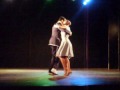
Here's Tete Rusconi, a true milonguero who feels the music in every cell of his body, having a great time performing a vals for his birthday at one of the "nuevo" venues in Buenos Aires. Looks like he and his partner are having a blast.
Improve your social dance skills and confidence; refine technique; develop better musical responses; increase your vocabulary of figures.
We can work with one or two people.
Cost: from $35 per person
Milongas
Nostalgias
Friday 18 September 8 - 11pm Walkerville RSL Club
Entry: $15 Bookings advised
Traditional Buenos Aires-style milonga - Invitations by cabeceo Best of tango music
Are cliques real?
-
Clique: A narrow exclusive circle or group of persons; esp: one held
together by presumed identity or interests, views, or purposes. Webster’s
Third Intern...
Are you a tango polymath?
-
Are You a Tango Polymath?
A *polymath* is someone whose knowledge spans multiple distinct
disciplines, demonstrating deep expertise or original achiev...
Biophysics of a Tango Embrace
-
I came across this video on YouTube and had to share it. The following text
is the comment I made after viewing the video. People around the world are
pass...
New website! www.tandaoftheweek.com
-
I'm happy to announce that Tanda of the Week has moved to a new platform
and domain. I will be recycling a lot of the original tandas from 2010-2017
a...
La chacarera (Country girl)
-
“La chacarera” must be one of Biagi’s most danceable tango classi.. “wait,
what? But Lucas, are you translating folklore now??? I did NOT sign up for
this!...
The beginner’s guide to the cabeceo
-
Originally written for 030tango in 2016. “I’ve never gotten the hang of
this cabeceo thing.”Many tango dancers will recognise this statement. Even
the adv...
Study
-
Some people like to study with championship tango dancers and watch videos
of championship tango dancers dancing tango so some day they may also win a
cham...
Welcome back...
-
...Tango and Chaos! On the off-chance I searched for it this morning, and
there it is again. Wonderful to see it back. However it might not display
properl...
Tango Argentino 1983 Eduardo Y Gloria
-
In this 15 minute video (click on CC for English Subtitles) Eduardo and
Gloria Arquimbau talk about some of the highlights of their 60 year tango
career...
Tonight I Can Write The Saddest Lines
-
Tonight I can write the saddest lines.
Write, for example,'The night is shattered
and the blue stars shiver in the distance.'
The night wind revolves in...
Watered-Down
-
A recent comment on “How We Teach and Promote Argentine Tango” and a recent
email seeking to organize a milonga (in the “Nuevo” style) brought us to
the re...
Indiferencia
-
Music: Rodolfo Biagi
Lyrics: Juan Carlos Thorry (what kind of name is Thorry?)
Notable performances: Juan d'Arienzo c Alberto Echague, Rodolfo Biagi c
Jorge...



.png)