Want to be able to dance confidently and feel comfortable in traditional milongas of Buenos Aires?
Our teaching develops your musicality, connection, technique & improvisation with social tango, as well as insights into tango culture and critical skills to build your confidence with milonga etiquette.


Showing posts with label pause. Show all posts

Thursday, 1 November 2018

Without the pause, there is no tango


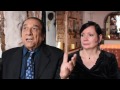
In this interview, Gabriel Misse talks about the importance of the milonga - where, he says, real traditional tango is danced.

Among his thoughts he also states: You have no pause, you have no tango. This got us  reflecting on how much we value the pause, as crucial to connection and musicality.  However, it's not easy.
Here's some food for thought:

What dancers might be experiencing at a pause
  • What's he doing now? (anxiety, apprehension, tension in the body, readiness to leap into an anticipated movement)
  • People might be watching me now that I've stopped (self-conciousness)
  • I don't think I have enough control to lead the pause effectively, and then hold it (fear of failure)
  • Ahh, I can put both feet down now, and have a rest (balance problems)
  • I'm not sure I can get the timing right moving out of the pause (lack of confidence in skills)
  • What figure is he going to do next? (brain in overdrive)
  • This feels beautiful. I'll savour the intimacy of this shared moment.
Certainly, the pause can be challenging until it's mastered.  But it's definitely worth the effort!

... and finally, a quote from Carlos Gavito:

I believe that tango isn't the dancing step but rather it's what's between one step and the next, where there's nothing, where the silences are, where the memory and remembered things are.

Tuesday, 9 May 2017

Dancing the pause


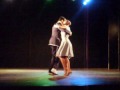
The 'pause' in tango is a powerful moment - just as in conversation when room is given to contemplate what has been said, to interpret, then respond.  There's stillness, which is far from inert.

At times, the dance-floor can appear as a place of constant motion.  This is to be expected with milonga, largely so with vals, but tango often invites the pause.  If we hear changing dynamics in the music, then it follows that our dance should reflect that.  In between the changes in dynamics, there can be times when we slow down, suspend the bodies, and let the music talk to us more intimately.

Carlos Gavito: "tango isn't the dancing step but rather it's what's between one step and the next, where there's nothing, where the silences are, where the memory and the remembered things are." *

However, the pause is not easy.  Some women have said that they adore the pause. Others that they find it physically challenging.  For the men, the challenges are everywhere - physically, mentally and emotionally.  I can think of at least 4 elements needed to exploit the beauty of the pause:
  • Good balance and posture
  • Anticipation of the dynamic changes in the music - which presupposes a familiarity with the music
  • Patience - holding it until the last possible moment
  • Self-confidence - to slowly come to a pause and remain suspended for a time
The dance doesn't stop during the pauses - there is still a tiny musical movement of the body.  It is a moment when nothing else exists apart from your partner and the music.

Carlos Gavito: "if it's true that tango is a sad feeling that we dance, then that means that it's an emotion, not a movement" *

* Interview with Carlos Gavito  in La Milonga Argentina April edition, pages 8-10, with English translation.
Bob

Popular posts