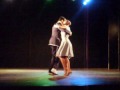
Want to be able to dance confidently and feel comfortable in traditional milongas of Buenos Aires?
Our teaching develops your musicality, connection, technique & improvisation with social tango, as well as insights into tango culture and critical skills to build your confidence with milonga etiquette.


Showing posts with label respect. Show all posts

Monday, 15 April 2024

Every little bit counts

After more than a week of dancing in traditional Buenos Aires milongas, I’m reminded of some of the social niceties which contribute to a harmonious dance floor as well as an enjoyable individual experience.  (Not a word about cabeceo here.  That topic has already had plenty of coverage.)

Each and every dancer makes a positive contribution to the milonga by:

* taking care of personal hygiene beforehand & avoiding strong scents

* changing into dance shoes in the bathrooms or away from the dance floor 

* when not dancing, ensuring that they aren’t blocking others’ line of sight. If standing to catch someone’s eye, then stand behind the tables

* entering the dance floor with care, with the man seeking and getting the nod of approval from the oncoming leader, and then entering before his partner, to protect her. Start to dance immediately, thus avoiding holdups 

* not eating/chewing while dancing

* chatting only in between songs on the dance floor. Need more time? Then sit down to have a conversation. Chatting while dancing spoils the tanda for dancers around you

* dancing small, keeping feet on the floor, especially in a busy milonga 

* dancing in the ronda, in your lane - neither tailgating nor holding up couples behind you 

* avoiding contact with other couples. Any collisions, even minor, warrant an apology or at least an acknowledgement 

* escorting ladies back to their table

* clearing the floor efficiently during the cortina.


I love how these small things - put together - add up to something greater than their sum.  Congratulations to dancers at La Milonguita in Adelaide who do this so well!

Pat

Friday, 30 August 2019

The Why, When and How of Feedback


When students talk about a recent difficulty which they've been experiencing in tango, one thing we look at is possible causes in their technique.  However, the unknown factor is what their partner at the time may have been contributing to the issue, especially if the student has come to us alone.

If we ask whether they tried to raise it with the partner (at a practica, or in class)
  • typically ladies will not have done so, for fear of bruising an ego  
  • on the other hand, a few men claim that the man is always at 'fault' when something isn't working in the dance!
Unfortunately, neither approach is likely to result in any improvement.  Clearly, open communication is the key to working out what might be happening and how to resolve it.

But when and how?

That's what practicas and classes are for!  The milonga is not the time.

So, how to broach the subject.  Criticizing your partner's technique presumes that you know best, and is most likely to put him/her on the defensive.  The last thing you want to do is hurt your partner's feelings. You want to find a solution together, not lose a friend.  Here are a few possible strategies:
  • "I feel + sensation + describe when it's happening" (Much more useful than saying "You are doing ...")
  • "Something doesn't seem to working.  Could we look at it together?"
  • Ask a teacher for advice together: "We're not sure what's happening here.  Could you take a look?"
Take a look at Veronica's very insightful article about why most advice you get about your dancing is wrong.

Remember, avoiding the issue doesn't help you nor your partner improve your dance.  For a long-term win-win outcome, approach it constructively and respectfully.

Pat

Wednesday, 3 April 2019

Codes and cabeceo


Interested in some of the finer points of  of the milonga codes and cabeceo?  Unsure how they might be of benefit?

Popular Argentine dancer and teacher, Oscar Casas, speaks of his experiences in this short interview:

Saturday, 14 July 2018

Just a friendly word of advice


At a practica (or even at a milonga, heaven forbid), has a dance partner given you advice about how to improve your tango?  Perhaps it was a suggestion about your embrace, your balance, your movements, etc.  Did the advice make sense to you?  Were you successful in putting the advice into practice?  If so, did you feel that it resulted in an improvement?

Most of us do want to improve.  And, I think I would be correct in saying that most of us would love dancers in our tango community to continue to improve, so we can enjoy more of those treasured tango moments.  For that reason, we might from time to time, be tempted to provide unsolicited advice when something isn't quite working while dancing.  But quite apart from the inappropriateness of 'teaching' in a milonga where we should dance as equals, will this advice actually be helpful to our partner?

Do we have sufficient expertise to analyse and advise on movement?  Do we have expertise in the opposite role?  Are we certain that we are not responsible, at least in part, for the 'problem'?  In a practica or in class, wouldn't it instead be more helpful to provide feedback to our partner about what we are feeling, experiment together, then if advice is needed, ask an expert?

Take a look at Why most advice you get about your dancing is wrong, by Veronica Toumanova.

PP

Thursday, 8 March 2018

Spot the beginner


A: "There she is. She's a beginner - she needs some advice. I'll give her the benefit of my expertise. After all, she'll feel grateful that someone with my experience is getting her up to dance."
(Why do some people feel the need to do this??)

B: "I was pushed and pulled all over the place. He was showing off, trying to get me to do his tricks. I had no idea what he wanted me to do, and I was made to feel like an idiot with everyone watching. He was in my ear all the time, telling me what to do - I couldn't focus on the music. Then, he used the breaks in the tanda to demonstrate figures to me. I'm new to tango and simply didn't know how to deal with the situation. I love the music, the dance, the connection, but after that, I just felt like going home."

Of course, there's an equivalent scenario with the roles reversed.

The fundamental element missing above is RESPECT. A good tango dancer (not necessarily one with lots of years of experience) will respect his/her partner - won't give unsolicited advice in the milonga, and will dance in a manner that is appropriate to the partner's current ability. The good dancer will, in fact, be able to enhance his/her partner's dancing as the tanda progresses. Yes, we may want to give our partner the benefit of our expertise, but that can be achieved through HOW we dance with them.

A good male dancer, for example, will start the tanda with a new partner by walking with sensitivity to the music - monitoring his partner's responses and accommodating, in order to instil confidence. Then maybe some small backward ochos, taking time to ensure that she completes her pivot before the next step, and being very explicit with the leads. The focus is on his partner, ensuring that she is comfortable and that the communication is working. Above all, a good dancer will respond to the music so she FEELS it through his body and his movements. During the tanda he'll check that she's feeling OK. You may ask: What about him? Well, this tanda is all about HER, as he does his best to convince her that tango is a dance of love - in many aspects.

So, how could a beginner deal with the humiliating treatment described earlier? She doesn't want to be labelled a snob by turning men away, thereby possibly reducing the chances of men inviting her to dance. On the other hand, she doesn't want to feel like someone's plaything.

Think of it this way: when it comes to unwelcome behaviours, tango is no different to other social situations. If she doesn't like what's happening to her, she doesn't have to put up with it. She could say something like:
  • "I'm sorry, but I don't feel comfortable with this right now. I'd rather sit down."
  • "I'm really not able to talk and dance at the same time."
  • "Thanks, but I need to sit down."
And in future, it's best to avoid the situation by actively using the cabeceo, and avoiding the gaze of certain people. It also pays to be armed with a response for unwelcome direct approaches - commonly used on beginners. If you'd rather not dance with someone, try something simple like: "Thanks, but not right now."

BTW. What do I mean by a 'good tango dancer'?
Someone who respects his/her partner and strives to make the tanda a positive experience; understands and practises the codes of the milonga; feels, connects with, and expresses the music in his/her dancing, and has the skills to execute tango movements which are appropriate in the social, sometimes crowded, context.

So, in the opening scenario, could you spot the real beginner?

Bob

Tuesday, 12 August 2014

Respect


Respect lies at the heart of tango, and it begins with that most respectful of invitations to dance – the cabeceo.

It continues with the embrace the man offers the woman – one of surrounding her with security.  An open embrace cannot provide this security, and one that puts her in strait-jacket does not respect her response.

So what else should the respectful man bring to his partner? Clear body communication and good body control will allow him to move with stability, balance, & precision.  Add to that a knowledge of tango music that will allow him to exhibit good musicality, with changing dynamics and energy.   He will have an ability to suggest the next movement …. and then wait for her response, finally moving with her.  His aim will be to create a resonance of movement and response to the music with his partner.  The bottom line – a constant focus on his partner: his lead, her response – as well as an acute awareness of the music.  Respect for her!

What can we say of the man who ignores much of this?  The man who believes that there is no reason to develop himself because he will dance anyway … most often by pressuring women with direct requests.  Is he disrespectful, arrogant, or just plain lazy?

Regardless of the answer, let’s encourage the men who show respect for women in their tango community by wanting to improve, using whatever means available to them. That involves more than going to lots of milongas and dancing every tanda in the same way.  Women deserve better than this! 

I suspect most women would gladly accept the cabeceo invitation of men who respect their partners - those men who make an ongoing effort to internalise the music and develop their social dancing skills. 

Bob

Popular posts