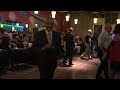
Want to be able to dance confidently and feel comfortable in traditional milongas of Buenos Aires?
Our teaching develops your musicality, connection, technique & improvisation with social tango, as well as insights into tango culture and critical skills to build your confidence with milonga etiquette.


Showing posts with label music. Show all posts

Thursday, 23 April 2026

To dance or not to dance?

Derrick del Pilar has skillfully translated the nostalgic classic Ninguna

Of the five different interpretations linked to the translation, can you tell which ones would have been arranged for dancers at the milonga?


Sunday, 6 July 2025

Tango covers

 Did you realise that the Golden Age tango orchestras were in fact cover bands?

Yes indeed!  The fabulous orchestras of Di Sarli, Troilo, Pugliese, D’Arienzo, and many more.


Usually they didn’t compose many of the pieces we associate with them eg. the dramatic Pugliese version of the  tango Chiqué, the Di Sarli versions of Champagne Tango. 


Often they also didn’t make the first recording of the piece either.  In other words, they were doing covers!  Look up some versions of your favourite pieces in Paul Bottomer’s YouTube channel https://www.youtube.com/channel/UCpMCDC6_cQ98mHzo-Yk1KUg/videos.  You might be quite surprised. 

An interesting example is the nostalgic classic Recién. It was composed by Osvaldo Pugliese in 1943, but first recorded in that year by the orchestra of Pedro Laurenz, then in 1944 by Ricardo Tanturi.  Pugliese didn’t get around to recording his version until 1980!

Which of these three versions of Recién do you prefer?  https://poesiadegotan.com/2009/05/13/recien-1943/
Which would you like to dance to?
PP

Friday, 5 June 2020

Who was Elvino VARDARO?


"... there was no other violin player like him."

By age 14, Vardaro was playing violin to silent movies and had met Rodolfo Biagi.  At age 17 he was invited to join Juan Maglio's orchestra, followed next year by joining Roberto Firpo.  Then at age 21, in 1922, he joined Pedro Maffia, where he played with Osvaldo Pugliese.

1929 - 1931: The Vardaro-Pugliese Sextet had formed with other prominent musicians, but in 1933 Pugliese left, and Vardaro formed a new sextet that included the 18 year old Aníbal Troilo.  Teh sextet was popular in cafes, cabarets and radio.  In 1938 he briefly payed with Lucio Demare, and in 1942 joined Osvaldo Fresedo's  orchestra where he played for several years.

During 1955- 1961, he alternated playing in the Astor Piazzolla and Carlos Di Sarli orchestras.

Yet, despite a pedigree like this, his sextet made only one test record - Tigre viejo, with the RCA Victor recording company in 1933.  It was deemed of little commercial value (looks like he was ahead of his time), so the disc was given to a member of the sextet.  Eventually his family preserved it in olive oil!  Much later it was cleaned up with Vaseline, and that's what you can listen to below.  Sadly, his sextet did not record any other music.

Michael Lavocah wrote "Tigre viejo is the closest thing to jazz that tango has to offer: six men playing on the edge of their seats, and just about keeping the whole thing on the rails."  See what you think:


The arrangement is quite experimental.  Remember, it was recorded in 1933!  Early in the piece, the sounds of a later Pugliese can be heard (although he was no longer in the sextet for the recording), and later you may pick up elements of Troilo.  Certainly quite jazzy in places.

Bob

For more information on Elvino Vardaro:


Monday, 11 May 2020

Irresistible Valses


By their nature, valses draw many dancers to the floor - they are rhythm-driven and contain exquisite moments.  But then there are those valses that won't allow red-blooded dancers to remain in their seats.

Here are five valses that I believe are unmissable and unforgettable.  Once you have danced to them, you'll be drawn back to the floor every time they are played.

Rodolfo Biagi Dichas que viví (1939) singer Andrés Falgás dancers Vanessa Villalba & Facundo Piñero.
This couple is sensational!

Juan Maglio Princesa (1931).
Don't you love that teasing introduction .... and the variación at the end?

Francisco Lomuto Idolatr

í

a (1937) singer Jorge Omar.

Carlos Di Sarli Alma mía (1940) singer Roberto Rufino

Osvaldo Pugliese Desde el alma.
Watch this performance. It was the only time that Pugliese was invited to perform at the Teatro Colón .... in 1985, at the end of his career.

Wednesday, 22 April 2020

Five tangazos


There are some tangos that totally transport me in a milonga - the body is governed by the heart, which is governed by the music.  No thought of  'steps'.  Each movement is my response to the feeling that the music provokes.  Maybe this is 'entrega' (surrender) - an informed passion discussed in Tango and Chaos.

I'm a lover of D'Arienzo's tangos with singer Echagüe - so much fun and room for improvisation coming from the strength of the rhythm.  However, the following selection of music will tell a story about how I also like to dance.  It was a hard choice, limited to one piece from five orchestras.  It doesn't include unmistakable tangazos from the likes of Caló/Podestá, D'Agostino/Vargas, Tanturi/Campos, etc.  You may wish to add your favourite tangazos to this list.

Carlos di Sarli - singer Roberto Rufino: Griseta 1941 (Lyrics: Poesía de gotán)

Juan D'Arienzo - singer Juan Carlos Lamas: Viejo tintero 1943

Enrique Rodríguez - singer Armando Moreno: Este es tu tango 1945

Aníbal Troilo - singer Alberto Marino: La luz de un fosforo 1943

Osvaldo Pugliese - La tupungatina 1952

… and one that wouldn't fit - Carlos Di Sarli - singer Roberto Florio: Cantemos Corazón 1956, beautifully danced by World Champions 2019 Agustina Piaggio and Maxim Gerasimov


It's interesting to look back at an earlier post Que tangazo! (2010), that drew several comments, illustrating just how personal the declaration "Tangazo!" can be.
Bob

Wednesday, 25 October 2017

Éste es tu tango


My wonderful porteña teacher of Spanish, who grew up listening to tango, once challenged me to name a tango which wasn't melancholic, sad or downright tragic. Considering the common tango themes of loss, nostalgia, betrayal, and heartbreak, Gabriela had a point.

Yet, one of my current favourite tangos is an exception.  Have you listened to the intensely romantic and danceable Éste es tu tango? It's so full of hope.

Imagine this scene in a milonga: a nervous young man smitten with a special young woman.  Her eyes show her interest. But he's too shy to look her way.  All this is observed by the singer, who urges him to take this precious opportunity for happiness.

Listen to this gem of a tango, while reading the lyrics, kindly translated by El tango te espera


And how would you dance to this?
PP

Monday, 30 January 2017

Music will make or break a milonga


I love the creative process of DJing, and watching dancers respond to the emotional journey created by the music.

But DJs take care! Music will make or break a milonga.  Nowadays, milonga attendees are increasingly sensitive to the music. Experienced dancers' tastes have developed & matured. Some prefer to attend milongas less frequently, dance less often (even though they would like to dance more), rather than tolerate poor musical selections. In Search of Tango articulates this quite strongly.

So, as a DJ, how do I know whether my musical choices are working during the milonga? What are the tell-tale signs?

Most of the people are dancing - obviously!
DJs who forget or ignore their milonga "clientele" are simply not doing their job.

For me, there are also other, perhaps less obvious, indicators of whether my DJing is hitting the mark:

Are the most experienced social dancers dancing?
If they are rarely dancing, or get up to dance only to return to their seats mid-tanda, I need to seriously reconsider my selections.

During tandas, do the dancers generally look absorbed in their dance?
If their facial expressions reflect detachment, puzzlement, boredom, etc., then the music is inappropriate.

Are the dancers moving in a fairly calm ronda? Is the dance-floor moving as a smooth stream, or is it more akin to choppy rapids?

At the end of the tandas, do the dancers appear satisfied as they return to their tables?

During the last part  of the milonga, is there still a good proportion of dancers on the floor?

I've been fortunate to be exposed to the DJing of masters such as Dany Borelli over many years attending Buenos Aires milongas, and have learned & continue to learn a great deal about what to do and what to avoid as a DJ. Aspiring DJs who are interested in learning, but who haven't been so lucky, still have good resources at their disposal via the internet. Some may also be able to consult with successful DJs in their community. They can, indeed must, do a lot of productive research and preparation before venturing out to DJ at a milonga. They shoulder a responsibility which should not be taken lightly.

Dancers deserve a quality experience, nothing less.

PP

Resources:
TangoDJ
TangoDJ fundamentals
DPP's Favourite Tandas

Monday, 9 January 2017

Music is the leader


Much is said about men as leaders, and there’s a lot of merit in “he leads, she responds, then he follows her”.  However, more fundamental to the dance is the ability of the couple to let the music lead them. Thanks Tango Therapist for articulating this concept. 
 
But it appears not everyone places such a supreme value on the music that they dance to.  This can be seen in: “I’ll dance tango to anything”, couples already on the dance floor before the music even starts, and others who carry on conversations during their tanda.  However, these are exceptions; I believe most dancers want to connect with the rhythms, emotions, and cadences of every piece that they dance.  To go some way to achieving this, some dancers even reserve a particular orchestra or a vals tanda for particular partners.

Listening is essential, and it starts with the man & woman listening to each other’s bodies at every moment, with every move, every lead and response.  Then there is a higher order skill – listening to and interpreting the music.  Higher order, because it is premised on good physical technique & control, a body memory of movements that will respond to music (rather than the dancer engaging in a thought-process), good floor-craft, a strong familiarity with the music, and a sensitivity & respect towards one’s partner.

So, is this listening to the music the man’s domain alone?   Absolutely not!  When I dance, I want my partner to hear the music, and to feel the congruence of my response to it.  I want to take her on a journey, but one that she will feel is guided by the nuances of the music.  If her total focus is ‘listening’ to my movements & responding to them, then she is not engaged with the music.

To listen to the music and be taken on this journey, a woman needs to trust her partner – trust that he will lead absolutely clearly, giving her the time she needs to respond; trust that she will be physically secure; trust that he is dancing for her, and not for himself; and trust that he is truly listening to the music.

Ladies, once you really listen to the music, you will be less likely to be surprised by any lead or timing, because it will “feel right”, and you will be more likely to respond in a way that will enhance the dance.  
Bob
 

Monday, 21 November 2016

Are you missing out?


At yesterday's milonga, a native Spanish-speaker remarked on the huge impact of the lyrics of tango on his dance. Some lyrics enriched his experience beyond description.

It makes sense when you think about it, doesn't it?  Consider for a moment those tangos which absolutely summon you to floor. You hear the opening bars of the piece and feel that you have to dance. I'll wager that it's the emotion of that music which plays a huge role in making you look around - almost with a sense of urgency - for a partner. How much stronger is that emotional response when you also know something of the story, or if you understand the lyrics as they are sung?

Tango is a feeling which we share when we dance with our partner. How much richer could that shared experience be, if we understood something of the poetry?

So, if you now suspect that you might be missing out, look up a few of your I've-got-to-dance-to-this tangos. You can read translations while you listen. Here are some of my favourites in Poesia de Gotán and Embrujamiento.  One website thoughtfully provides subtitled Youtube videos, too!

Here's one of my favourite Pugliese tangos subtitled by Tango Decoder:


PP

Monday, 5 October 2015

Random tanda thoughts

Adelaide has just finished hosting a lovely long-weekend of tango, bringing together dancers and DJs from far and wide, including New Zealand! No workshops, just social dancing. It was delightful discovering 'new' dance partners and having the opportunity to reconnect with 'old' ones.

This brought me to reflect on a sense of being somewhat short-changed at times. Allow me to explain: I would be enjoying a lovely dance with someone I hadn't seen in 12 months or so, and after 3 tangos the cortina was already playing. Or my new partner and I were just 'getting to know' each other in our first ever tanda together - really starting to connect during the second track of the tanda, and found that there was only one tango left to enjoy.

People who prefer three tango tandas often express the opinion that the arrangement allows dancers to circulate more and therefore dance with more people at the milonga. I can see that viewpoint.  However, that argument doesn't seem to work for those of us who perhaps prefer to dance less often, but with partners we really want to dance with. A four tango tanda leaves me feeling pleasantly satisfied and ready to happily float back to my table, rather than the sensation of an unfinished dish being snatched away from me by an over-zealous restaurant waiter.

I'm sure some will read this post and vigorously shake their heads.  They might even label my views as anti-tango community.  But there you are....

On another tanda note...
I recently came across this interesting background of the origin of the tanda.
PP


Sunday, 8 February 2015

Can you feel it?


While driving the other day, I put on some dance classics of Pedro Laurenz. As I was listening and enjoying the music (Recién, Como dos extraños, etc.), I turned up the volume a little.

Suddenly the music’s impact on me changed completely. No longer was I merely listening, I was feeling. The volume had not been increased excessively, but the effect was remarkable. Previously, I had been able to hear and appreciate the instruments and singer quite clearly, but with a small turn of the dial, the emotion of the music took over. My response to the music was no longer cerebral, it had become visceral.

No wonder I don’t feel inspired to dance even my favourite tangos at a milonga, if the volume is too low. Perhaps this statement doesn’t apply to everyone, but I believe that the desire to dance is primarily physical and emotional, rather than a cerebral response. The music should invade your body, pick you up and carry you away.

Some folk, it seems, will dance to any music. They’re up on the floor, in the embrace, ready to dance, before the tanda even starts. Internally, I shake my head, puzzled about what they might be feeling. If they are feeling! Perhaps tango for them is more akin to physical exercise. To each his own, I suppose….

Then you have the analytical approach. This dancer tries to extract and express every musical nuance in a tango. This dancer has a bad case of Too much musicality.  Is anything gained by intellectualising the dance like this? What is the point of trying to score as many musical points as possible in one tango? Does this approach contribute to social tango?

Dancing tango is simple – simply dance the feeling.

PP

Monday, 26 January 2015

Happy Birthday, Ricardo Tanturi!


El caballero del tango was born 27 January 1905, and was in his prime as a pianist, composer and most prominently as a band leader during the Golden Age of Tango. Collaborating with the popular singer Alberto Castillo, and then the more romantic voice of Enrique Campos, his orquesta produced numerous classics which I find simply irresistible. No traditional milonga is complete without Tanturi!

Perhaps the best known of these classics outside Argentina is Una emoción which featured in the credits of the film Assassination tango.

Listen to DDP's Favourite Tanturi Tandas which feature links to DDP's lovingly crafted translations of the lyrics. Tanda of the Week also treats us to a number of Tanturi treasures.

And for the more visually-oriented, take a look at milonguero Rubén Harymbat & Enriqueta Kleinman dancing to Recuerdo malevo (Tanturi/Castillo), and Carlitos Espinoza & Noelia Hurtado performing to Calla bandoneón (Tanturi/Campos).
PP

Saturday, 10 January 2015

Getting the music #2


One good way of improving your tango is to listen to Golden Age dance music - a lot!

You start hearing, feeling and responding to more and more elements of this rich, multi-layered music. Ah, what a delicious pleasure it is to dance with someone who really gets the music.

But what about all those fabulous, danceable tangazos which are sung? What might you be missing if you don't understand Spanish, or in many cases Lunfardo? Some people dismiss the lyrics as unimportant. I've even heard tango lyrics derided as merely variations on the "She done him wrong" theme. But there's so much more to these stories of the barrio. I've found that having even a small inkling of the story to which I'm dancing totally enriches my tango experience.

Fortunately, a number of dedicated and talented souls are opening these doors to non-Spanish speaking tango enthusiasts. Take a look and get lost on the blogs of Poesía de Gotán, Tango Decoder and Embrujamiento.

Look up some of your favourite tangos, and then see if things change for you next time you dance.
PP

Thursday, 17 July 2014

Do cortinas matter?


How important is a cortina, apart from clearing the dance-floor between tandas?

     Does it affect the mood and energy of the milonga? 
     Might it complement or clash with the preceding music? 
     What is the ideal length of a cortina?
     Is it a problem if the same cortina is used all the time? 
     Should the DJ bother with this, and just focus on the tandas?

Well, I'm going to have a little gripe. I wish more DJs would indeed consider the contribution of the cortina. I've seen the mood created by the most thoughtful selection of music spoiled by a cortina which is soporific & energy-sapping or jarringly inappropriate.

Cortinas which allow dancers to not only clear the floor, but are also long enough to return to one's seat, have a drink and reconnect with those around, are considerate of the dancers.  So, nowadays my cortinas are usually around one minute in length, and that seems to work well.

Personally, I like using a variety of cortinas to complement or spice up the mood during a milonga - not too gloomy or bland.  On the other hand, the Heavy Metal cortinas which I heard some years ago in Buenos Aires, of all places, were way beyond the pale. Some current favourites: Pretty woman (Roy Orbison), Words of love (Mamas & Papas), Son of a Preacher Man (Dusty Springfield), Back to black (Amy Winehouse), Hard times (Ray Charles), Breaking up is hard to do (Neil Sedaka).

Am I being too precious? Does the cortina really matter at all? Next time you're at a milonga, take note and decide for yourself.
PP

Sunday, 27 October 2013

Happy Birthday, Miguel Calo!

Born 28 October 1907, Miguel Calo collaborated with many of the greats of the Golden Age during his tango career - as bandoneonist, band-leader and composer.

Many a dedicated tanguero would declare a milonga incomplete without a tanda of Calo with singer Raul Beron. Yet, I suspect few know that this immortal collaboration almost came to a very premature end.  Calo's orchestra was broadcasting at a radio station, and the station executives apparently felt that Beron was not up to their standards.  So, they told Calo to sack him, which he did.  But the just-recorded Al compas del corazon became a hit.

Fortunately, they had second thoughts. Otherwise, we would never enjoyed the exquisite Jamas retornaras.

Calo also recorded gems with Alberto Podesta, including Dos fracasos. And here's the goosebump-inducing Que falta que me haces 1961, performed by Javier Rodriguez and his first partner Geraldine Rojas. It's a study in restrained intensity.

Trenzas, recorded with singer Raul Iriarte, was said to be a favourite piece of the late Andrea Misse. Here she is dancing to Trenzas with Javier Rodriguez.

Thursday, 8 August 2013

Two for the price of one

Prominent tango orchestra directors of the Golden Age made use of several singers in their repertoires.  Who can forget Carlos Di Sarli with Roberto Rufino, Jorge Duran or Alberto Podesta? Juan D'Arienzo's best known singers Alberto Echague, Hector Maure and Armando Laborde also brought different qualities to the orchestra, and strongly influenced the end-product. The same could be said about most other great Golden Age orchestras. But seldom did the singers actually share the same stage.

As orchestra director, Alfredo De Angelis cleverly chose to combine the complementary qualities of his singers, more often than most. Carlos Dante teamed up with De Angelis in 1944 and in the same year was joined by Julio Martel. Recording 17 numbers together, they became the best known De Angelis duo.What a treat it would have been to see them live!


Want to hear more?  Here's a great tanda of tangos to feast upon.

And to finish - a dessert. One of my all-time favourite De Angelis / Dante & Martel valses: Pobre flor, playfully performed by the vals specialists, Julio Balmaceda and Corina de la Rosa.

PP

Thursday, 14 March 2013

Manos brujas

Happy Birthday, Rodolfo Biagi!

Nicknamed Manos brujas (spellbinding hands), some would say that Biagi's playful, staccato and upbeat style was critical to Juan D'Arienzo achieving such success, and bringing tango to a huge number of dancers.

In 1935, at the tender age of 19, Biagi was recruited as the pianist for D'Arienzo's orchestra. And what an energising impact he had! The story goes that one night D'Arienzo was running late for a gig, so the orchestra started playing without him, with Biagi setting the pace.  The public went wild and the rest is history.

It's interesting to compare Biagi's style in Paciencia (1937) with Fulvio Salamanca's in No mientas recorded only two years after Biagi had left to form his own orchestra. Both are D'Arienzo tangazos with excellent pianists, but Biagi stands out for me.  It's as though his fingers are smouldering on those piano keys.  Yet his restraint keeps us wanting more.

Here are Dany and Lucy, organisers of El Maipu (one of my favourite Buenos Aires milongas) dancing to Biagi's Quiero verte una vez mas after the crowd has gone home.

But best of all, are Biagi's playful valses. Who could possibly resist Dichas que vivi?

PP

Thursday, 7 February 2013

Osvaldo Pugliese

Who has not fallen under the spell of Pugliese's music? Even if you are one of the few who haven't, you may still enjoy this brief but beautiful video collage of the Maestro's life, thoughts and music.

Sunday, 18 November 2012

The dance-floor’s full - the music must be good!


I’ve sometimes heard this comment at milongas when feeling grumpy about the music and unmotivated to dance.  Lots of dancers are on the floor, but most are not dancing to the music.  OK, I realise that we all hear music a bit differently.  But in truth, I can see little connection between their movement and the music being played. Besides, the music is not calling me to dance.

So what could have gone wrong?  Humans naturally want to move to dance music, unless that innate response has been inhibited.  (Take a look at Tangotherapist’s blogs on The psychology of musicality & don’t miss the baby dancing!).  Perhaps something else could be amiss. In any young tango community (outside of the Rio de la Plata region) most dancers will come to tango unfamiliar with the music. So their teachers have a major responsibility to consistently expose them to it.  I mean quality tango music composed and arranged for social dancing (here are some useful guides) – not tango music intended just for listening (eg. Astor Piazzolla – marvellous music, but not for social dancing).  

Newcomers to tango are like empty vessels ready to be filled.  So if they are fed a diet of high quality danceable tango music, their tastes are nurtured, their tango growth thrives.  The music and the social dance form start to make sense - they form a coherent unit.  More and more dancers will feel the music calling them to respond in certain ways.  They may experience the wonderful union of the music, their partner and the other couples on the dance-floor, and may unexpectedly encounter that fleeting state of tango bliss.  And then they’ll want more!  But if quality dance music - one of the key ingredients - is lacking, then it’s not likely to happen.  Dancers may persist and continue to seek out that elusive tango high, but will leave disappointed.  

Those of us in young tango communities who choose to DJ bear a significant responsibility.  We can make or break a milonga with our musical choices.  In the long term, DJs can influence the musical tastes of dancers in that community.  When DJing, I love sharing high quality danceable gems of the Golden Age of tango.  I get great satisfaction from seeing dancers responding to the call of the music.  Yet DJing is not a task to be undertaken lightly.  At a milonga a good DJ chooses music suitable to the dancers, reads & influences peoples’ emotions and helps shape the event.  Take a look at Ms Hedgehog’s DJ questionnaire Was that good? and think about your milonga experiences.  

Teachers and DJs – I beg of you, don’t ignore an important aspect your role in young tango communities – that of educating and nurturing the tastes of developing tango dancers.  

Note. In the interests of full disclosure, I admit that this plea contains a degree of self-interest: at milongas I’d love to enjoy the music and dance!

PP

Saturday, 22 September 2012

Happy Birthday, Alberto Podestá!

This living legend of tango turns 82 today and he's still singing to appreciative audiences in Buenos Aires.

Di Sarli recruited him at the tender age of 18 and later he also went on to sing with Pedro Laurenz - two of the great orquestas of the Golden Age.  For more about his interesting career, read this interview in Todotango where you can also listen to a number of his hits.  Bill recently forwarded this lovely Youtube video of a recent sub-titled interview with the great man.

When it comes to romantic tangos and valses, he's a master.  Don't Sebastian and Maria Ines capture the romance of Junto a tu corazon beautifully in this performance?

PP

Popular posts