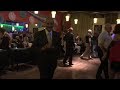
Want to be able to dance confidently and feel comfortable in traditional milongas of Buenos Aires?
Our teaching develops your musicality, connection, technique & improvisation with social tango, as well as insights into tango culture and critical skills to build your confidence with milonga etiquette.


Sunday, 17 April 2011

Dodgems on the dance-floor


Ever been dancing at a milonga and felt like you have suddenly been transported to a fairground? Instead of being in a comfortable embrace with your partner, flowing magically with the music, you feel you have both been teleported into the seats of a dodgem car. All your efforts are being directed towards avoiding the next crash.

Sometimes things change dramatically at milongas, even milongas where the line of dance is normally respected and dancers are considerate to one another. For any number of reasons, the dynamics on a night can be suddenly different and the floor-craft unpredictable. When driving on a busy road, you need to assume that the other motorists will abide by the road-rules and will drive in a predictable fashion. If not, you would be constantly on high alert, trying to avoid collisions. Social dancers also require predictability from their peers in order to relax and connect with their partner and the music. Gentlemen, you need to “dance with” the couple ahead of, behind and beside you.

We are all responsible, to a greater or lesser extent, for what happens on the dance-floor. So, what can you do, if you find yourself dancing with a partner (male or female) whose behaviour is erratic? Well, for a start, you might be a little more discerning in your choice of dance partner. But, perhaps their behaviour has taken you by surprise. You are dancing the first of four tangos together and you’re getting worried. You have already collided with another couple, and to make things worse, no apology was made. What are your options?
  1. Go with their flow and not worry about the people dancing around you.
  2. Tighten your embrace, try to slow things down and hope that your partner becomes aware of your discomfort.
  3. Say that you are feeling uncomfortable.
  4. Say that you are feeling uncomfortable and return to your seat.
  5. Any other ideas?
As I have mentioned before, the etiquette of the milongas is based on respect for others. The codes evolved over some time, hence can be considered “tried and true”. Their purpose is to reduce tensions and discomfort, thereby maximising harmony during this social event.
When someone’s behaviour had been inappropriate, I have witnessed the organiser of a milonga in Buenos Aires taking the person aside and explaining what is expected. Some organisers refund the person’s money and simply ask them to leave. Better that than have everyone else’s fun spoiled, as well as the reputation of their milonga. Offenders whose response is “But we didn’t actually collide with anyone!” fail to understand that their erratic behavior means that because of them, no-one else can relax and enjoy themselves.
In extreme cases, I have seen ladies use their prerogative and desert their partner on the floor mid-tanda. What else should she do if he just won’t take a hint and continues to make her look incompetent in front of everyone? And of course gentlemen, you too can escort your partner off the floor if she fails to curb her exhibitionist streak and insists on behaviour that endangers others.
On the other hand, some people are just too nice. They feel uncomfortable and do nothing. They are afraid of offending. Ladies have confessed to being afraid that that person won’t invite them to dance again. And the result? In the long-term they actually do the offender a disservice. The anti-social behavior is reinforced. Sadly, that person won’t realise that their behaviour is inappropriate. They miss an opportunity to reflect on whether their skills need development so they can be more in control of their navigation.
Now, see if you can identify the code which wasn’t followed in this video which was taken in a BsAs milonga (hint: 4.20mins). Unfortunately, it led to a dancer being injured and having to leave the floor.
PP

Monday, 28 March 2011

How would you like your piropo?

Adios ángel con alas en los pies. (Farewell angel, with winged feet). Ladies, how might you feel if after dancing together, a tanguero whispered this to you? Or, De qué estrella te caíste? (Which star did you fall from?) Would you feel outrage for being objectified by a man? Or pleasure at the chivalrous attention?

A year or so ago, when the award-winning Argentine feature film El secreto de sus ojos (The secret in their eyes) was released here, an ex-patriot porteño expressed delight with several piropos (flirtatious compliments), peppered through the early part of the movie. I think that he felt a twinge of nostalgia for his home-town and the local practice of a man expressing appreciation for a woman, traditionally done in clever, poetic form. This has been described as the habit of delivering a verbal flower to the ladies that pass by … (Sergio). A crude wolf-whistle hardly has the same effect!

Call me old-fashioned, but IMHO the piropo belongs perfectly in traditional tango culture, where the woman is respected and treasured. Men are macho, but not in the sense often used by gringos. Totango’s article about male & female roles, and tango gender equality provides a revealing insight into this side of tango.

Some say that the piropo is dying out, losing its poetry and becoming more mundane. Certainly Qué ojos! (What eyes!) is less likely to enchant, than Dame de tus ojos la alegría y de tu boca dame la vida (From your eyes give me joy and from your lips give me life) Luis Alberto. Perhaps Argentine men are becoming a little too busy and too stressed nowadays to come up with witty metaphors.

On the other hand, for Valentine’s Day this year, the organisers of La Milonguita ran a competition for the best piropo. The many clever entries show that this tradition is alive and well after all, at least in Argentina!

PP

Thursday, 17 March 2011

What makes a good milonga?

There are many elements that contribute to you saying as you travel home, “that was a good milonga”. Four stand out in my opinion:

Welcoming organisers
They make you feel that you belong and therefore influence the mood of the dancers. Visitors are especially made to feel welcome; shown to where they can sit, and maybe introduced to local dancers.

The codes
This concerns the milonga behaviour that the organisers promote, and the respect which the dancers, in return, have for the codes of the particular milonga. The codes will influence the dancers’ floor-craft and can enhance the harmony, trust, relaxation, sense of community, and cooperation during the milonga.

The venue
Ideally, it is visually appealing, has good ambience and suitable floor. The furniture can be arranged around the dance space to bring the dancers and the ‘watchers’ close…. as well as providing good visual contact for the cabeceo. The venue needs to ‘retain’ the energy of the dancers, rather than allowing it to dissipate. It needs a good sound system which is loud enough to ‘carry’ the dancers, without being harsh on the ears - the music needs to envelope the dancers.

The music
Even if the other elements don’t quite measure up, you simply can’t get past this one. If the music doesn’t work, then it’s unrealistic to think it can be a good milonga. The music is crucial in determining and charting the mood of dancers from the beginning of the milonga to its end. It needs to be the result of knowledgeable and extensive preparation – there are no short-cuts. Near enough is not good enough, and is in fact a long way from ‘satisfactory’, let alone ‘exhilarating’, when it comes to the music.

You can read more on this topic on Tango Australia in Music maketh the milonga

…. and to see all of this coming together, take a look at the recent opening of Cachirulo at Villa Malcolm, where you’ll see organizers Héctor & Norma, DJ Carlos Rey, the codes printed in several languages, great floor-craft and a beautiful venue.

Bob.

Wednesday, 23 February 2011

Códigos de la milonga #9 - La pista

Scenario 26
Imagine the scene at a milonga. The music has started, couples have begun to dance. You’ve just made eye contact with your next partner, with whom you haven’t danced for a while. Choose the most suitable behavior:
  1. The man rushes across the dance-floor to embrace his partner, narrowly missing a couple already dancing.
  2. You’re both on the dance-floor. Before taking up the embrace, you greet your partner and ask how they are, what they’ve been up to, etc.
  3. You meet your partner and make your way straight onto the dance-floor. The other dancers will accommodate you both.
  4. You meet your partner, find a safe gap in the lane of dancers, perhaps making eye contact with the couple approaching and then you merge quickly into the flow.
The correct answer isn’t rocket-science, particularly for most of us who have driver’s licences. (Option 4, in case you were unsure) Yet, it’s surprising how often people forget to consider their fellow dancers. Jan, of Tango Chamuyo provides some useful insights in La pista sagrada (the sacred dancefloor).
And while I’m on the topic of respect for other dancers, in Tango & Chaos in BsAs, Rick McGarrey shares excellent practical advice (replete with graphics) on the challenging skill of navigation. If you are a pusher, a dawdler, or simply see yourself as a free spirit on the pista, this is essential reading!
PP

Friday, 11 February 2011

Esta noche de luna

What affects the way you dance a tango at any one time? Probably, there are countless influences, some may be conscious (your dance partner, the physical environment, the preceding music, the energy of the milonga, etc.). I suspect that there are yet more influences lurking in the subconscious.

What of the tango music itself? Different parts may speak to you. At times, you may find the singer is demanding your attention, whereas previously you were responding to the piano. A knowledge of the lyrics, or at least the theme, of the tango will also play its part and enrich your response. Each time you dance to that same piece it will be a different experience . Isn’t that one of the joys of tango?

I was delighted to find the beautiful translation of one of my favourite romantic tangos Esta noche de luna on Derrick del Pilar’s website. Read, listen and be transported!

Now how might you dance to this gorgeous music? The following clips show very different interpretations of the very same tango played by Carlos Di Sarli’s orchestra with the superb voice of Roberto Rufino . These dancers are all performing for an audience, some may have choreographed their dance and include very impressive manoeuvres, others are improvising and dancing in an understated manner, suited for the salon, with a focus on dancing to the feeling. What I found especially interesting was their musicality, their choices of how to respond and what to respond to in the music.

PP


Popular posts