Want to be able to dance confidently and feel comfortable in traditional milongas of Buenos Aires?
Our teaching develops your musicality, connection, technique & improvisation with social tango, as well as insights into tango culture and critical skills to build your confidence with milonga etiquette.


Friday, 11 February 2011

Esta noche de luna

What affects the way you dance a tango at any one time? Probably, there are countless influences, some may be conscious (your dance partner, the physical environment, the preceding music, the energy of the milonga, etc.). I suspect that there are yet more influences lurking in the subconscious.

What of the tango music itself? Different parts may speak to you. At times, you may find the singer is demanding your attention, whereas previously you were responding to the piano. A knowledge of the lyrics, or at least the theme, of the tango will also play its part and enrich your response. Each time you dance to that same piece it will be a different experience . Isn’t that one of the joys of tango?

I was delighted to find the beautiful translation of one of my favourite romantic tangos Esta noche de luna on Derrick del Pilar’s website. Read, listen and be transported!

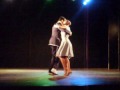
Now how might you dance to this gorgeous music? The following clips show very different interpretations of the very same tango played by Carlos Di Sarli’s orchestra with the superb voice of Roberto Rufino . These dancers are all performing for an audience, some may have choreographed their dance and include very impressive manoeuvres, others are improvising and dancing in an understated manner, suited for the salon, with a focus on dancing to the feeling. What I found especially interesting was their musicality, their choices of how to respond and what to respond to in the music.

PP


Wednesday, 26 January 2011

Tango lives of milongueros

For anyone interested in the traditions of tango, the interviews with milongueros on Mónica Paz and Chan Park's blog PractiMilonguero are gold. The recently recorded videos (sub-titled in English) not only convey the unveiled passion each milonguero has for tango, but also shows us glimpses of their personal history. Chan and Mónica are to be congratulated for this valuable initiative which captures some of the story of tango.

Definitely unmissable viewing! The final treat at the end of each clip: we get to see each milonguero dancing.

Here's the latest, quite moving, video of Ricardo "Tito" Franquelo. I hope you enjoy it as much as I did.

PP

Friday, 7 January 2011

Respect

Perhaps there ought to be a sign at the entrance of milongas which reminds patrons that teaching on the dance-floor is inappropriate.

Here’s another idea: suggest to the would-be tutors of tango that they hire their own teaching venue for instructional purposes rather than exploiting a milonga.

OK, let me totally frank about this: I believe that providing unsolicited advice to one’s partner at a milonga is disrespectful and offensive behaviour.

Regardless of the intention (e.g. “helping” a less experienced partner, wanting to execute one’s favourite moves, etc.) it’s just not on! And to those who reluctantly put up with it, or even feel grateful for it, let me repeat: It’s just not on! And you shouldn’t put up with it. In fact by tolerating it, you are encouraging the behaviour, and therefore are a part of the problem.

When an invitation to dance is accepted at a milonga, it should be on the premise that the two parties would like the pleasure of dancing together to that particular tanda of music (Dancing as equals). Besides, to be in the moment and really dance tango together, you have to focus on the music and your partner, not be distracted by an explanation of the technicalities of a figure. That’s what lessons and practicas are for.

Not only is this behaviour offensive to the recipient, it also disrupts the flow of the dancers at the milonga. A well-functioning ronda relies upon all the dancers (especially the men) cooperating with each other, some would say dancing with each other, hence enabling the couples to proceed in the line of dance without interference. Stopping to teach your partner on the pista would hardly endear you to your fellow dancers who are banking up behind you or are attempting to avoid you. In fact, it’s a recipe for chaos on the dance-floor.

Finally, I find the instructions which are audible to all those around the would-be tutor & partner so distracting, that I lose focus even when my favourite pieces of music are playing.

So what could be your options if this happens to you:
· Accept the advice with gratitude or in silence – Definitely not recommended
· Say: I simply can’t dance and talk.
· Say: Could we discuss this later, off the floor?
· Say: Thank-you and return to your seat.
· Say: Do you want to dance with me or teach me?
· If you’re a woman say: If you can lead it, I’ll try to follow.
· Never dance with this partner again.
· Look around and discover that it’s often the poorer dancers who are the advice-givers.

Perhaps rehearsing a suitable response would be helpful to some. A consistent approach to this issue could well lead to some noticeable changes in behaviour.

Am I alone in these sentiments?
PP

Wednesday, 22 December 2010

Dancing as equals

While chatting with a local lady in El Arranque (a milonga in BsAs) about the nature of ‘connection’ in tango, she said that “the man and woman need to dance as equals if they are to truly achieve connection in tango.”

This made me examine my mentality when I dance with ladies whose skills and experience vary greatly. For example, many of the women with whom I dance at milongas in my home city, are those that I have taught or currently teach - including beginners. Elsewhere, including in BsAs, I have danced with some women who force me to work hard to simply maintain my axis, and with others who are acclaimed ‘maestras’.

The question I had to ask myself was: "How can we dance as equals?" For me, it's about how I approach the relationship with the woman I'm going to dance with. If there's any thought, for example, of superiority on my part or inferiority on hers, then the relationship we are seeking is doomed from the start, and there’ll be no chance of that elusive connection in our tango. If I have any feeling of anxiety or intimidation when I dance with women who are clearly more experienced and skilled than me, then I won’t experience connection with them in the embrace.

And this is what I found in BsAs - the women I danced with love tango. Some sang in my ear. We danced for each other - there was nothing in our brief relationships that suggested anything but equality. We used all of our skills to bring the music into our dance, and we brought ourselves confidently into a collaborative relationship. I felt we were dancing as equals – and that’s the only way tango can be danced, in my opinion.

There is no reason why this mentality can’t prevail wherever I dance tango – but it needs to be shared – the women need to feel this way too: they need to feel self-confident and they need to trust.

Bob

Monday, 20 December 2010

Less is more

Just found this superb video of María Inés Bogado y Sebastian Jiménez, the current Tango Salón champions performing in Valencia (Spain). There is so much that can be learned from this recording of just 3 minutes! Their musicality is brilliant, with clever changes of dynamic executed with total control and excellent technique. The connection is utterly palpable. A brilliant performance where colgadas, volcadas, ganchos etc., fashionable in some tango circles, would have been totally superfluous.

So what can be learned by ‘mere tango mortals’ which could be of any use to dancing socially in the milonga from this outstanding performance? Many things, I think.

But let me focus on only her footwork. Why? Because it’s perfect for dancing in a crowded milonga, and it is simply beautiful! So many ladies in tango frantically try to execute adornos (decorations) as a way to express themselves, often to the detriment of their partner, the music, the dancers around them, let alone their own elegance. I’ve expressed my views on this topic in the past.

Interestingly, María Inés dances with few explicit adornos, and they are done with understatement and sensuality. Yet who could say that her footwork is not exquisite and utterly mesmerising? I simply wish that ladies wanting to add a little spice to their social dancing, would focus more on walking elegantly and using their feet beautifully.

PP

Popular posts