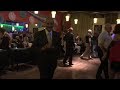
Want to be able to dance confidently and feel comfortable in traditional milongas of Buenos Aires?
Our teaching develops your musicality, connection, technique & improvisation with social tango, as well as insights into tango culture and critical skills to build your confidence with milonga etiquette.


Wednesday, 19 October 2011

Tango your life - the doco

The trailer of Chan Park's film Tango your life shows tantalising clips of our favourite Buenos Aires milongas with lots of familiar faces.

It's now an entry in the ArcLight Documentary Film Festival where the 10 entries with the most "likes" will be accepted into the festival. So visit this Youtube link, enjoy and vote. 

Asi se baile el tango! 

Friday, 7 October 2011

Too much musicality?

Does that sound sacrilegious? Is it hard to imagine? Can you conceive of situations where too much focus on the music might ruin the social dance?

Finding this concept difficult? That's not at all surprising.

For some years, we and others who love social tango, have been critical of the emphasis which some dancers and teachers place on "doing steps", even mini-choreographies, at the expense of the music and the other dancers at a milonga. We are not alone in the belief that the social dance-floor of the milonga is not the place for dancers to act out their aspirations for the stage - their flamboyant and erratic movements interfering with the flow of the dance-floor. Besides, any experienced dancer will tell you that dancing with someone who is struggling with fancy steps is no fun at all. Connection and musicality are far more enjoyable.

Yet some recent experiences in Europe illustrated to us that the social dance experience may also be compromised by dancers trying excessively to interpret the music. Dare we say that some try to play - perhaps a touch  too cleverly -  with the minutiae of the music.

So, what could be wrong with trying to do justice to the music? Nothing at all. Dancing is a physical and emotional response to music. But it seems that when the intellect gets too involved in this process, the social dance suffers.

A joy in tango is dancing with a partner and being carried away with the phrasing, rhythms, melodies and interplay of instruments in that great treasure-trove of music. However, like most things in life, this can be taken to an extreme. Trying to represent each and every nuance, syncopation and off-beat contained in a piece brings with it the danger of a stilted dance experience - for the couple and for those around them on the dance-floor. The dance is then in danger of becoming an intellectual, interpretive exercise. One can simply try too hard to be musical.

Milongueros such as Osvaldo Centena and the late, great Ricardo Vidort are just two examples of playful and fluid musicality on the social dance-floor. It's pretty safe to say that they danced what their bodies felt in the music. As a result, their dance is a fluid and comfortable experience. (Pat speaks from personal experience of dancing with El Oso).

So, returning to the initial question. Sadly, in some respects, too much musicality in the dance is indeed possible. The intellect should not dominate the dance, whether it's by over-analysis of the music, or attempts to reproduce certain "steps". Anything resulting in a stilted and contrived dance, will be in conflict with social tango.

Wednesday, 10 August 2011

What’s in a name? Comme il faut

What is comme il faut? No, it’s not the shoes!

The literal translation from the French (according to our French-English dictionary) is "How Things Are Done," but that doesn't begin to describe it.
It's about manners, and behaving properly in polite society, and keeping your cool under provocation (both verbal and physical).
It's behaving like a lady, or acting like a gentleman.
It's that very rare quality in today's self-promoting, blame-shifting, tell-all society known as class.

When we named our new milonga Comme il faut just 4 years ago, it was very much a case of our belief in “how a milonga should be”. From spending a month in Buenos Aires every year since 1999, we have come to embrace the style of milonga that we believe to be typical of the ‘Mecca of tango’.

We wanted to cultivate some of the important elements that we value at the more traditional milongas in BsAs. Many hours spent in Maipu 444 watching and dancing, while absorbing the music of master DJ Carlos Rey, have provided a thorough education in what makes a successful milonga.

Consequently, we chose a venue which has character – a 1920s golf club – with a relatively small salon, accommodating around 55 people. With the tables arranged tightly around the dance floor, those who watching are always in close contact with those who are dancing. It also makes possible and encourages the use of the cabeceo. The size of the dance floor requires dancers to have good navigation skills, respect the line of dance, and dance appropriately. So it follows that elaborate performance figures and activities that disturb other dancers (eg. high boleos) are not welcome …… and we haven’t been shy in asking ladies to keep their heels close to the floor. We are delighted that there seems to be an understanding that good floor-craft and care for other dancers are the norms at Comme il faut.

The other guiding influence is has been the DJ culture of Buenos Aires. Pat’s music is largely the best of the Golden Age, with playlists influenced by the likes of Carlos Rey, Mario Orlando, and Dany Borelli. Persistence with this wonderful music at Comme il faut, has meant that local dancers are now saying that they have come to love the music of that period.

So why do we, in Australia, want to promote a milonga modeled on our favourites in Buenos Aires? For a start, it’s what we love, and we want to share what we believe is a genuine tango experience with local dancers. There’s also the reality that many dancers of all abilities are holidaying in Buenos Aires, with the intention of dancing tango there. What we offer is a snapshot of what to expect. As a result, dancers may recognize the changes they may need to make to their current style of dancing in order to fit in. After all, many milongas in BsAs are much more crowded than here. Good navigation skills are essential. Sacadas, volcadas, & colgadas are rarities in the traditional milongas. Better to learn this before arriving in BsAs than experiencing a rude shock.

Should all milongas be modeled on the traditional BsAs ones? Well, if they were, we would love every minute of them. However, other people insist that home-grown milongas should not try to copy BsAs, but have their own local style. What do you think?

Bob.


Wednesday, 20 July 2011

What IS that smell???

Before attending a social function such as a milonga, there are certain things many of us take for granted in our society: taking a shower, brushing our teeth, wearing clean clothes, taking along some breath mints. Some men who perspire heavily have been known to thoughtfully bring along a spare shirt to change into. Tangueras really do appreciate men who make an effort.

However, as in all matters, there are people attending milongas who just don’t understand the Less is more concept. And I’m not referring to their dancing! I’m thinking about the ladies and gentlemen who feel the need to douse themselves with their favourite, expensive perfume and then share it around each time they embrace someone. Surely just a hint of scent should be enough – elegant sufficiency, n’est ce pas? Instead, we sometimes leave milongas wearing a sundry mélange of designer eau de parfum. OK, I’m lucky enough not to suffer from allergies and I can wash it off when I get home. So what’s the fuss all about?

A few weeks ago, we discovered an odour emanating from my significant other’s clothes. It was rather feminine, floral and quite pervasive. (He’s got another woman! I thought.) The smell had spread through four jackets & six shirts like an out-of-control virus. Finally, we managed to track down the source to one of the jackets he’d worn to a milonga. No amount of airing could get rid of it. Now, he’s patiently & forensically working towards identifying the culprit!

On another note, Tango Goddess shares an amusing anecdote about a totally different type of assault on the olfactory system.

PP

Wednesday, 29 June 2011

Who's afraid of close embrace?

We all need it! We all love it! But are you afraid of a hug?

The close embrace is a defining feature of traditional tango. Within that comfortable, safe hug, we can relax, and allow our bodies to respond naturally to the music and communicate non-verbally.

Movement invites Movement
compares the "frame" of Ballroom Dancing with the tango embrace in one of their blogs. Take a look. I know which option I prefer.

I love how Osvaldo Centena and Ana Maria Schapira are totally connected within their wonderful embrace as they dance to this D'Arienzo classic.


PP

Popular posts