Want to be able to dance confidently and feel comfortable in traditional milongas of Buenos Aires?
Our teaching develops your musicality, connection, technique & improvisation with social tango, as well as insights into tango culture and critical skills to build your confidence with milonga etiquette.


Friday, 28 May 2010

Que tangazo!

Ever wondered what makes a great tango?

A local ex-porteño ( … mm, I’m not sure if you can ever stop being a porteño) was recently commenting on some tango music. Like many natives of Buenos Aires, he grew up listening to tangos, but he never learned to dance it. Anyway, I digress.

On hearing D’Arienzo’s interpretation of Pensaló bien, he commented, “My mother would have said: Que tangazo!” I got his drift, but didn’t know exactly what he meant by tangazo. So he dutifully emailed me a grammatical explanation of augmentative suffixes in Spanish. Still, a question remained for me: What makes a good tango a tangazo? Does it simply come down to individual preference?

Later I pressed him further. He thought there would be some common denominators of tangazos. But what were they? He consulted a Uruguayan tangophile who lives interstate, and after some lengthy discussion, this is what they came up with:
  1. Lyrics which scratch below the skin because they 'say something'
  2. Music which is good to dance or listen to
  3. Longevity - people listen to those tangos over the years, the 'guardia vieja' and the new generation alike enjoy them. They never die.
  4. A fan of Troilo (bandoneon as the lead instrument) as compared to a fan of D'Arienzo (piano as the lead instrument) would have different lists of tangazos
So that made me wonder whether some instrumental tangos make the grade?

What about great valses and milongas? I’ve only heard the diminuitive term: valsecito, rather than an augmented version. Could there be a reason for this?

Anyway, here are a few pieces (links to lyrics, music and translations) which I consider tangazos. Of course, you may have a different view altogether about whether these could be considered tangazos. Indeed, there may well be other definitions of tangazos. If so, I’d love to hear from you.

PP
Gloria (De Angelis/Dante)
Adiós Arrabal (D’Agostino/Vargas)
El Adiós (Donato/Lagos)
Mandria (D’Arienzo/Echagüe)
Tristezas de la Calle Corrientes (Troilo/Fiorentino)
Poema (Canaro/Maida)

Wednesday, 12 May 2010

Dancing in Buenos Aires

If ever I’m asked about what it’s like dancing in the milongas in Buenos Aires, my first response is, "It depends". For a start, it depends on which milongas, and we choose our milongas carefully. But the more important response is, “It depends on whether we go in as a couple or as singles”. The milonga experience is quite different in the two scenarios.

When we go to neighbourhood milongas like Sin Rumbo, La Baldosa, Sunderland, Circulo Trovador, we tend to go as a couple because they are traditional, largely ‘couples’ milongas. That means we dance just with each other, unless we’re attending with friends. Here we can relax, knowing how each other dances, take a few risks, but always respecting the local codes and the local dancers. It’s a nice feeling to be accepted, and to be part of the local tango community at these milongas.

However, Cachirulo, El Beso, Lujos, Canning (Saturdays) are very different – largely for singles, with a high standard of dancing. Immediately, there are elements of tension and uncertainty to deal with. Using the cabeceo to gain dances with partners who we’ve identified we’d like to dance with – that can take time & patience, and can be a bit nerve-wracking. Others need to be aware that we can dance well before they’re going to look in our respective directions – so whenever we dance, it needs to be neat with good connection with partner and music …. and, of course, always respecting the codes!

The first embrace with a new partner is a defining moment – it tells our partner a lot about us as dancers. As a leader, I need to instill confidence in my partner immediately, so that she can relax into the expectation that she’ll have a good dance experience and that she’ll be safe. My dancing needs to be very focussed – on my partner’s ability, her responses, and my musicality …… the range of ‘figures’ is almost irrelevant. She wants to dance tango and I need to accommodate her idiosyncrasies. Within these parameters, the tanda needs to be an enjoyable experience for both of us accompanied by a necessary level of tension to keep us sharp.

Which experience is better? They are simply different …… and it’s gratifying to be able to choose and reap the rewards of both.

Bob.

Monday, 5 April 2010

The singer - just another instrument in D’Arienzo’s orchestra?

Juan D’Arienzo, the King of Rhythm apparently once said that the human voice should be no more than an instrument in the tango orchestra. He blamed the declining popularity of tango in the late forties on the starring role of the singers. However, thanks to D’Arienzo’s high energy tangos, valses and milongas, dancers continued to be drawn irresistibly to the dance-floor.

He recorded with a large number of singers, yet I find myself returning to just two of them: Alberto Echagüe and Hector Mauré. Despite his views on the singer’s role, these fellows certainly left their very distinctive imprints on their recordings with D’Arienzo, perhaps despite him! The hard voice of Echagüe reminds us that the stories of these pieces – in this case Pensalo bien - are usually set in uncompromising, working-class neighbourhoods. Here's a treat - a historic video clip of Alberto Echagüe singing Paciencia with D'Arienzo's orchestra.

Contrast that with Hector Mauré singing Amarras whose more refined voice lends everything a more romantic feel. Which is better? Just depends on the mood. I love dancing to them both.

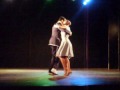
Finally, Geraldine and Javier perform to Humillación sung by Mauré


Do you prefer to dance just to instrumentals, or do you like the singers, too?

PP

Saturday, 20 March 2010

Tango as a journey

Like many gringos, we were first attracted to tango many years ago by stage tango (tango escenario). The powerful music of Piazzolla also played a large role at the time. Much later we discovered that the flamboyant, exhibition-oriented dancing was the flip-side of the tango coin to social tango.

Both are part of tango culture. One is quite rightly aimed at entertaining the audience with highly skilled and impressive figures and combinations. On the other hand, social tango (tango salón) is more subtle and internal. Each dancer has to tune in to their partner’s non-verbal communication in this improvised dance. And for me, that’s much more engaging. Each person’s communication style and response to the music will be different. So every tanda is potentially a private voyage of discovery for each person.

We dance tango salón for our partner in a milonga, alongside many other couples, who are engaging in their own private journeys for the duration of the tanda. Because we are sharing the dance-floor, the códigos of the milonga (milonga etiquette) evolved to meet the needs of all these folk, of course.

Some travel to Buenos Aires to immerse themselves in tango culture, including the códigos, which can be challenging, at least initially. Tangocherie’s blog and comments to - Why do some people bother to come to Buenos Aires to dance? – are a must to read, especially if you plan to make the journey.

PP

Monday, 1 March 2010

Sensitive Golden Age Guys

Some say that tango is a man's world. And it may indeed appear so.

At the milonga - men traditionally invite and lead. Now let's look at the musicians, singers, composers and lyricists - mostly men. South America is traditionally known for its machismo. Men are powerful. They call the shots. Or do they?

Taking a close look at the lyrics of many tangos will reveal another perspective altogether. Rather than self-aggrandisement, a great many tangos lament men's mistakes, weaknesses, losses, regrets, betrayal, etc. Far from trumpeting macho achievement and strength, we hear them admitting to their failures - usually in matters of the heart. Trasnochando, Gloria and Idilio trunco are just a few of the many examples which we can listen to, while reading the translations.

Perhaps we see a different side of the Argentine man through these tangos.

Finally, here's Di Sarli's version of the irresistible Patotero sentimental (sentimental gangster) danced by Cristina Sosa and Daniel Nacucchio:


PP

Popular posts