Want to be able to dance confidently and feel comfortable in traditional milongas of Buenos Aires?
Our teaching develops your musicality, connection, technique & improvisation with social tango, as well as insights into tango culture and critical skills to build your confidence with milonga etiquette.


Sunday, 25 November 2018

The amazing Roberto Segarra

 
He'd be seen sweeping ladies, young and old, off their feet at Buenos Aires milonga venues, such as Obelisco Tango.  We'd shake our heads and wonder how he did it.  Last May we saw him, as always in great form at the ripe old age of 97!!  Born in 1920, he had danced to the great Golden Age orchestras playing live.  Imagine that!

However, his time had to come. We heard of his passing this month through Janis Kenyon's blog.

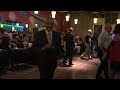
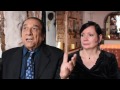
Here is the sprightly Roberto dancing, along with a brief interview (with English sub-titles) about his life in tango.


We'll miss your gleeful smile and joyful dance, Roberto.

Thursday, 1 November 2018

Without the pause, there is no tango


In this interview, Gabriel Misse talks about the importance of the milonga - where, he says, real traditional tango is danced.

Among his thoughts he also states: You have no pause, you have no tango. This got us  reflecting on how much we value the pause, as crucial to connection and musicality.  However, it's not easy.
Here's some food for thought:

What dancers might be experiencing at a pause
  • What's he doing now? (anxiety, apprehension, tension in the body, readiness to leap into an anticipated movement)
  • People might be watching me now that I've stopped (self-conciousness)
  • I don't think I have enough control to lead the pause effectively, and then hold it (fear of failure)
  • Ahh, I can put both feet down now, and have a rest (balance problems)
  • I'm not sure I can get the timing right moving out of the pause (lack of confidence in skills)
  • What figure is he going to do next? (brain in overdrive)
  • This feels beautiful. I'll savour the intimacy of this shared moment.
Certainly, the pause can be challenging until it's mastered.  But it's definitely worth the effort!

... and finally, a quote from Carlos Gavito:

I believe that tango isn't the dancing step but rather it's what's between one step and the next, where there's nothing, where the silences are, where the memory and remembered things are.

Thursday, 4 October 2018

Sore tango feet?


Just back from the very successful Tango in the Spring event in Canberra, Australia - a lovely opportunity to immerse oneself in Golden Age tango.

But, all those hours of milongas can take their toll.  Sore feet was not an unusual topic of conversation.  Some might say that it's a good problem to have - implying that they should be happy, because they did lots of dancing.  Does one inevitably follow the other?

Well, I'll let you into a secret.  You can have your (milonga) cake and eat it, too!

Here are some tips:
  • Keep your body in shape
    If you can easily maintain a good posture in the embrace, keeping your axis aligned over the weight-bearing knee, then you are more likely to be using your foot efficiently. (You'll find it harder to pivot, if your weight is on the outside of your foot.)   Poor distribution of weight can also lead to injuries.
    You might try exercises for the feet and ankles, too.

  • Select well-fitting and well-cushioned shoes
    Our feet weren't designed to walk in high heels. So, we will be asking for more trouble wearing shoes which are also too tight, too loose, un-cushioned, etc.  (Note. Good padding for the balls of the feet becomes even more important, as we get older.) 
    The shoes may be pretty. They may be a bargain. But, trust me, you'll regret it unless they are really comfortable from the start!  Just ask yourself how many pairs of rejected tango shoes you have stashed away, or given away.  If you're like me, it will be too many to admit to!

  • Keep heels and balls of both feet in contact with the floor
    Why dance just on the balls of your feet (unless pivoting, of course)?  Use your heels and your metatarsals. 
    While extending into a back-step, keep the metatarsals (not only the toes) in contact with the floor.  Lifting and placing your foot, will mean that each step effectively impacts the floor. Ouch!
    These techniques also ground us and help with our balance.

  • Choose partners carefully
    You don't have to dance with anyone and everyone.  If you know that someone's dance style causes you discomfort, then you don't have to accept the invitation.  Use the cabeceo to avoid this, or politely refuse.

  • Take a break
    Perhaps you've just danced a lovely tanda, and feel like basking in the lingering pleasure. Maybe the person you hoped to dance with to this next tanda is already dancing. Or, the music being played doesn't inspire you to dance.
    No problem.  Sit and watch the dancers, enjoy the music, or have a chat. Your feet will appreciate the break.

  • Ice
    Keep a small plastic bottle of water in the freezer at home. If you do get sore feet, cover the frozen bottle with several layers of newspaper or a cloth, and roll your bare foot over it on the floor for 5 minutes or so.  The cold reduces inflammation.  The improvement is amazing and lasts!
Of course, for ongoing problems, you should get professional advice.

I hope this helps.  You may have additional tips to share.  Would love to hear from you.
PP

Thursday, 9 August 2018

Musical chairs in the milonga


Are you a milonga gypsy?  Or do you like to return to your own chair after dancing? 

So, what's the fuss about seating at milongas?

Consider this real-life scenario (only names have been changed):

Joanne and Phil normally arrive at milongas fairly early.  Among other things, they like to take their pick of seats before the milonga gets busy.

After a hectic week, they headed out to relax at a local milonga.  Having paid the entrada and found a nice spot to sit, Harry slung his coat over his chair with his phone safely tucked in the coat pocket out of harm's way.

Many people arrived, and as the milonga became busier, each new arrival tried to work out where there was a free place to sit.  To avoid any unpleasantness, before sitting down most new arrivals politely tried to confirm with those sitting at a table, whether a place was available.  Sometimes they would get it wrong, and the recent arrival would have to gather up their belongings and find another spot.  At times, this was accompanied by some awkwardness.

Meanwhile, Joanne and Phil had been enjoying the milonga.  Returning to his chair after a tanda, Phil found someone else sitting there, engrossed in an animated conversation.  Having nowhere else to sit, and being far too polite to say anything, Phil waited patiently.  Then he realised that the 'visitor' was not only sitting on his freshly dry-cleaned coat, but probably also on his phone!  Still he said nothing!!  Instead he continued to wait ... somewhat anxiously.  (Politeness can be taken a touch too far.)

Fortunately, the phone was undamaged, and Phil was able eventually to reclaim his seat.  No harm done.  

But, could you imagine some better alternatives to this scenario?  Allow me to suggest a few improvements:

Organisers provide sufficient seating for everyone
This ensures that each person has somewhere for their jacket, drink, mints, fan, etc.

Organisers keep an eye on seating
They make the effort to indicate comfortable options for each person when they arrive, rather than leaving dancers to their own devices after taking their money.  This also prevents congestion in any one area, thereby reducing obstructions on the dance-floor.

Dancers return to their seat at the end of tandas
If you have been 'visiting' another table for a chat, you return to your seat (or go elsewhere, such as the bar) at the end of the tanda.  This ensures that the 'owner' of that spot has somewhere to sit when they have finished dancing. 
Returning to your seat also facilitates the cabeceo, because potential dance partners will know where to look for you.  In fact, sitting down during the cortina helps everyone in the milonga.  If people are standing and chatting on the dance-floor in between tandas, your line of sight may be blocked.  With everyone seated, you can easily look at potential partners, if you wish to dance the coming tanda.

PP

Saturday, 14 July 2018

Just a friendly word of advice


At a practica (or even at a milonga, heaven forbid), has a dance partner given you advice about how to improve your tango?  Perhaps it was a suggestion about your embrace, your balance, your movements, etc.  Did the advice make sense to you?  Were you successful in putting the advice into practice?  If so, did you feel that it resulted in an improvement?

Most of us do want to improve.  And, I think I would be correct in saying that most of us would love dancers in our tango community to continue to improve, so we can enjoy more of those treasured tango moments.  For that reason, we might from time to time, be tempted to provide unsolicited advice when something isn't quite working while dancing.  But quite apart from the inappropriateness of 'teaching' in a milonga where we should dance as equals, will this advice actually be helpful to our partner?

Do we have sufficient expertise to analyse and advise on movement?  Do we have expertise in the opposite role?  Are we certain that we are not responsible, at least in part, for the 'problem'?  In a practica or in class, wouldn't it instead be more helpful to provide feedback to our partner about what we are feeling, experiment together, then if advice is needed, ask an expert?

Take a look at Why most advice you get about your dancing is wrong, by Veronica Toumanova.

PP

Popular posts