Want to be able to dance confidently and feel comfortable in traditional milongas of Buenos Aires?
Our teaching develops your musicality, connection, technique & improvisation with social tango, as well as insights into tango culture and critical skills to build your confidence with milonga etiquette.


Wednesday, 25 December 2013

Express yourself!


How many times have you heard these exhortations from teachers of tango:

Allow yourself to be transported by the music.
Focus on the connection with your partner and the music.
Develop your own personal style.

I believe in these statements.  So, why was I aghast when a couple in a milonga was doing their own thing (in concert with the music), executing bizarre, disturbing movements reminiscent of a stage show?

Fortunately, there were no collisions with other dancers or surrounding objects. It was not a case of Dodgems on the dance-floor.  However, their dancing was incongruous with that of other couples around them in the ronda. They seemed unaware of their disruptive influence on an otherwise harmonious dance-floor.

The person sitting next to me was more forgiving and remarked that they were simply expressing themselves. No doubt, they were dancing tango in the way familiar to themselves.  They appeared to be having a good time, and isn't that the most important thing?  It made me ask myself if I had become grouchy and intolerant of styles different to my own.  Was I being too sensitive and critical?  I think not, but that's a somewhat biased opinion, of course!

It seemed that the couple had not internalised a basic fact: Tango is, above all, a Social Dance.

Perhaps they had never been taught the skills and awareness enabling them to dance with the other couples in the ronda.  Maybe the distinction between performance and social tango had never been made clear, ie. social tango is not primarily for the entertainment of onlookers.  Carlitos and Noelia show us the difference, and the contrast could hardly be greater: performance and social tango.

Tango therapist's social tango etiquette emphasizes consideration and respect for the surrounding couples.  Why? Because surrendering to the music and your partner in an intimate embrace requires us to trust not only our partner, but also trust those dancing nearby - something we cannot do if collisions seem likely.

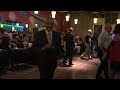
Here are snippets of milongas in Chan Park's documentary trailer, showing how we can express ourselves in the dance and allow those around us to do the same.
PP

Friday, 22 November 2013

State of mind


Recently, a gentleman in our tango community shared a most insightful observation. Dancing good tango begins with your state of mind. Probably, this will come as no surprise. But how often do we enter the dance-floor of the milonga mentally unprepared?

At a milonga, do you
  • dance most tandas, regardless of the music, OR dance only when the music really summons you?
  • dance with almost anyone, OR accept invitations (via cabeceo or otherwise) only from people you want to dance with?
  • chat while dancing, OR reserve the conversation for when the music has stopped?
  • simply assume that your partner will understand you, OR focus on communicating very clearly?
  • if you're in the male role, lead tentatively, OR express your clear intention each and every step of the way?
  • if you're in the female role, try to predict what your partner will lead next, OR allow yourself to be relaxed, receptive and responsive?
  • try to impress onlookers with tricky moves, OR dedicate yourself to dancing just for your partner?
There are no prizes for guessing the correct answers! In my opinion, dancing real tango requires focus and mindfulness.

And to close, here's a challenge from Ricardo Vidort, a late, great milonguero quoted in Tango and Chaos in BsAsWhen you dance tango, you must give everything. If you can't do that, don't dance.
PP

Sunday, 27 October 2013

Happy Birthday, Miguel Calo!

Born 28 October 1907, Miguel Calo collaborated with many of the greats of the Golden Age during his tango career - as bandoneonist, band-leader and composer.

Many a dedicated tanguero would declare a milonga incomplete without a tanda of Calo with singer Raul Beron. Yet, I suspect few know that this immortal collaboration almost came to a very premature end.  Calo's orchestra was broadcasting at a radio station, and the station executives apparently felt that Beron was not up to their standards.  So, they told Calo to sack him, which he did.  But the just-recorded Al compas del corazon became a hit.

Fortunately, they had second thoughts. Otherwise, we would never enjoyed the exquisite Jamas retornaras.

Calo also recorded gems with Alberto Podesta, including Dos fracasos. And here's the goosebump-inducing Que falta que me haces 1961, performed by Javier Rodriguez and his first partner Geraldine Rojas. It's a study in restrained intensity.

Trenzas, recorded with singer Raul Iriarte, was said to be a favourite piece of the late Andrea Misse. Here she is dancing to Trenzas with Javier Rodriguez.

Wednesday, 4 September 2013

Territorial tendencies

Have you ever been dancing, blissfully transported by the music and your partner, only to be rudely shaken by another couple colliding with you? They appeared, seemingly out of nowhere, moving out of the line of dance. Adding insult to injury, they made no sign of apology and danced on oblivious.

Humans are, by nature, territorial animals. They can exhibit aggression when someone tries to muscle onto their patch. Milongueros in Buenos Aires protect their partner and their space in the ronda.

Of course, they are not immune to feelings of annoyance when subjected to an intrusion. In the early days of tango, knife fights reportedly took place, perhaps over a woman or due to lack of respect on the dance-floor. Nowadays, the milonga tends to be a more civilised environment - on the surface, at least.

Codes of etiquette in traditional Buenos Aires milongas evolved to prevent violent encounters, and to curb other anti-social behaviours associated with the primitive part of our brains.

When even a minor collision happens on the dance-floor, the male dancers immediately signal an apology to each other.  This happens even if the dancer was not responsible for the collision. It keeps the peace.  It shows respect.

I suspect that those who don't do this in BsAs are considered no better than barbarians.

So, how do you deal with such mishaps on the dance-floor?

PP

Thursday, 8 August 2013

Two for the price of one

Prominent tango orchestra directors of the Golden Age made use of several singers in their repertoires.  Who can forget Carlos Di Sarli with Roberto Rufino, Jorge Duran or Alberto Podesta? Juan D'Arienzo's best known singers Alberto Echague, Hector Maure and Armando Laborde also brought different qualities to the orchestra, and strongly influenced the end-product. The same could be said about most other great Golden Age orchestras. But seldom did the singers actually share the same stage.

As orchestra director, Alfredo De Angelis cleverly chose to combine the complementary qualities of his singers, more often than most. Carlos Dante teamed up with De Angelis in 1944 and in the same year was joined by Julio Martel. Recording 17 numbers together, they became the best known De Angelis duo.What a treat it would have been to see them live!


Want to hear more?  Here's a great tanda of tangos to feast upon.

And to finish - a dessert. One of my all-time favourite De Angelis / Dante & Martel valses: Pobre flor, playfully performed by the vals specialists, Julio Balmaceda and Corina de la Rosa.

PP

Popular posts