Want to be able to dance confidently and feel comfortable in traditional milongas of Buenos Aires?
Our teaching develops your musicality, connection, technique & improvisation with social tango, as well as insights into tango culture and critical skills to build your confidence with milonga etiquette.


Wednesday, 21 March 2012

The importance of detail

After our tango class, R (one of our students) was at home relaxing; watching snowboarding competitions on TV. A remark from one of the expert commentators resonated with him so much, he felt the urge to share it with us today. 

"What's really important is to do the small things really well".

Thursday, 8 March 2012

One of the great voices of tango

Enrique Inocencio Troncone would have celebrated his 99th birthday on Saturday 10 March.  Never heard of him? When Ricardo Tanturi  needed "a different voice" to replace the distinctive and most successful Alberto Castillo, he knew about Enrique's abilities. But before joining Tanturi's orquesta  Los Indios, Enrique needed to find himself a suitable stage name. Thus emerged the romantic and intense combination Tanturi and Campos.   For anyone interested, Todotango provides an interesting insight into how and why the stage name was chosen.

Enrique Campos' voice became another significant instrument in Los Indios, one of the great and very popular dance orquestas. Occasionally, I've heard a few dancers complain that they don't like dancing to sung tangos. Some say this is because they can't understand  the lyrics.  But you don't have to understand a word of Castellano to get the feelings throughout La abandoné y no sabía, Una emoción, Oigo tu voz and Recién, to name but a few. Thanks to Derrick Del Pilar you can simultaneously listen to these great tangos, read the original lyrics & the English translations. And as for dancing the emotions of Tanturi con Campos, Javier Rodriguez and the late Andrea Missé's performance of Oigo tu voz in Sydney last year gives me goose-bumps.

PP


Thursday, 16 February 2012

How do I tell him?

Sometimes we float on a cloud of blissful ignorance. Most of us are afflicted by some form of myopia.  Yet ignorance is no excuse in the eyes of the law. Just try to explain to a police officer that you didn't know about a speed limit.

OK, at most milongas the organisers won't impose a fine for anti-social behaviour, but most socially aware adults would certainly disapprove of those who make us feel uncomfortable.There tends to be a fairly common understanding in social groups about these matters. Lacking the courage to confront a person directly, people often grumble about the offending behaviour amongst themselves.

Are any of these "oversights" familiar?
> Too busy to take a quick shower before heading to the milonga?  No problems, just spray on some deodorant or cologne.
> No time to iron a clean shirt?  Easy, a T-shirt will do.
> Forgot to brush your teeth?  Just pop some breath mints.

Sorry, that's simply not good enough in this intimate dance. Your dance partners won't enjoy being subjected to that, despite your superb dancing skills! Most of them will simply be too polite to say anything to you, but that won't stop them from thinking it and having second thoughts about dancing with you!

On the other hand, those ladies and gentlemen who make an effort are considerate to those they dance with.  Looking and feeling good also helps boost the confidence.  And in this dance, we can all do with that!

PP

Saturday, 28 January 2012

I like the way you walk

Is this the highest praise that a tango dancer can receive from an old tanguero?  I believe so; what do you think?  Of course, the embrace and the dancer’s posture are all part of this judgment.
You would think that since walking is something that we do every day, that this would be the easiest part of tango, yet I am convinced that achieving a good ‘tango walk’ is the hardest.  However, if you get this right, then everything else flows easily …. because so much goes with it – balance, strong axis, good embrace, clear lead-follow from the body, close stepping to your partner, effective contra-body rotation.
So why do people have so much trouble with the walk in the embrace?  For a start, they are in an unfamiliar position physically and mentally – in front of and chest-to-chest with a partner.  This in itself creates some anxiety, including the leader’s fear of stepping on his partner’s toes.  Bodies become tense – shoulders, back, arms – defeating any chance of walking normally.  On the other hand, with a relaxed body and a forward advance of the leader’s torso before he steps, there is little chance of him getting near her toes. A leader who leans back, or dances totally vertical, has more chance of clashing with his partner’s legs or feet, because he is keeping her in his space.
Walking in an embrace requires trust - trust that the follower will move with her partner’s lead, and trust that the leader will follow her. The embrace is something that shouldn’t be broken – whether it’s during a simple walk or a complex turn.
Musicality is the next level that needs to be built into walking; confident musicality and confident walking are mutually dependent. Apart from walking on the beat (but not necessarily every beat), musical walking means an injection of energy corresponding to the phrase of the music.  It needs commas & periods, acceleration & deceleration, suspension & relaxation.  If the movements correspond to the music, then you get good, confident walking. It will simply feel right!
There’s another quality that can be added to the dance - resisting the urge to step on every beat. This doesn’t imply that the dance stops at various moments, but rather that the ‘pause’ has value.  It’s a response to the music, which can include small decorations or a gentle body movement into the next step.  Think of a conversation – the silences can be powerful, just as the pause in tango can be.
In some ways it’s no different to a respectful conversation: I say something – she listens - then gives me her response - I pay attention and wait until she finishes talking - before I have something more to say, etc. Such are the essentials of a satisfying conversation, or a deeply satisfying tango.
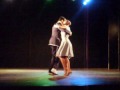
A controlled and elegant tango walk, combined with a strong sense of where the music is taking you, contains the essential elements of a beautiful tango.  Jorge & Samantha Dispari illustrate this in a post-class demonstration; the film quality could be better, but the impression that it made on me is indelible.


Bob

Monday, 2 January 2012

Ladies in waiting

No, this isn’t a reference to serving the royals, but rather a key element of the dance. Anticipation by followers is a hazard for their leaders and can destroy the timing & interpretation of the music that defines each tango; it also affects the leaders’ balance & posture as well as making them tense & watchful – not great for improvisation. I’m talking about guessing at what’s coming next & stepping into it, rather than intuitiveness with regard to timing & rhythms that comes with long experience.

So what can help women wait for the lead (a proposal) instead of moving ahead of her partner? Maybe looking at some possible causes will provide some clues. I’d suggest that it begins in the woman’s head – does she have confidence in her own skills and trust in her partner? From the beginner, who can do no more than walk well with good posture, to the dancer who has a broad range of well-developed skills, she needs to have a sense of self-belief – a belief that she can do what she does well - regardless of the partner (provided, of course, he can lead effectively). This confidence will translate to her being prepared to wait for a clear, well-timed lead – after all, rushing ahead can mean the moment is lost, whereas if she takes her time, the man has no alternative but to wait for her.

Clearly, this assumes that the man leads in a manner that will generate trust in his partner. He needs to quickly assess what his partner can do well, and dance within that range in order to make it an enjoyable tango for them both. He also needs to subscribe to the principle that he leads (proposes), the woman follows (listens and then responds in her own time), and he follows her (when the music invites). Which sounds very much like the leader needs to listen to and wait for the follower!

In fact, it’s that constant & well-timed two-way communication between the two bodies which can result in a truly satisfying tango.

So what can you (leader or follower) do if you find yourself dancing with a partner who doesn’t wait?

Bob

Popular posts