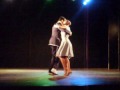
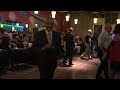
Want to be able to dance confidently and feel comfortable in traditional milongas of Buenos Aires?
Our teaching develops your musicality, connection, technique & improvisation with social tango, as well as insights into tango culture and critical skills to build your confidence with milonga etiquette.


Wednesday, 22 September 2010

Milongueando en Buenos Aires

Four weeks in the Mecca of tango are drawing to a rapid close and the farewells to friends (old and new) are almost complete.

Attending milongas almost each evening, mostly as singles, caused me to reflect on the milonga experience. One thing that stands out is that it´s not only about the dance. For me, the milonga package is much more. Certainly most of us are there to dance, but those who make the most of it also use the milonga as an opportunity to socialise, be transported by great music, relax and observe.

After dancing an especially satisfying tanda, I find myself preferring to come back down to Earth gently, rather than looking out for an invitation to dance again right away. So, watching the dancers on the floor is a good way to signal that I want to sit out the tanda.

If my attention is drawn to any particular dancers, it´s usually because their movement is an expression of the emotion contained in the music. Their connection seems both physical and intuitive. At the same time there is an utmost consideration for the dancers around them. From all this flows a spontaneous creativity and satisfaction which only the couple themselves can fully appreciate.

Finally, how wonderful it is to experience the harmony of movement and energy when all the dancers on the floor are on the same wave-length!

PP (in BsAs)

Monday, 26 July 2010

Decorations - a contradiction in terms

Recently it dawned on me that decorations, adornos, embellishments (call them what you will) could well be considered a contradiction in terms - unless executed for a tango performance.

Under most circumstances in life, a decoration is an external embellishment. Yet an adorno in social tango comes from within and remains within the embrace. It's not primarily for the viewing public. It is a spontaneous expression of the emotion of the music. It does not disturb our partner. It isn't calculated or premeditated. However, sound technique and control underpin any elegant adornment.

What is a decoration in social tango? To me it begins with the way in which dancers (male or female) use their feet when taking a step.

For anyone interested in this topic, I recommend very highly the articles by Olga Besio and Milena Plebs (in Spanish & English).

PP

Friday, 9 July 2010

Milongueros in action


I’m delighted! At last, I’ve found a series of Youtube videos featuring milongueros of Buenos Aires doing what they love – not performing, but dancing socially in the milonga.

That’s when they’re at their best: feeling the music, dancing with real connection to their partner; dancing with and for her, and at the same time, showing the utmost consideration for dancers around them.

They keep their partner safe in their embrace, allowing her to relax and respond calmly & intuitively. You can see the look of serenity, almost meditation, on the faces of the women in these videos. Tangopilgrim hit the nail on the head, when quoting his teacher: The most important dance is the one that happens inside us.

Don’t do anything, unless you feel you have to. And do anything that you feel you have to do. (Tangopilgrim)
These milongueros and their partners are dancing in the moment. They are both being carried by the demands of the music and all its rhythmic variations, and savouring each second.

Thanks, Irene and Man Yung (video above) and Jantango , for recording and posting these gems on your sites.

PP

Tuesday, 29 June 2010

El abrazo

“I want to dance tango” is heard often from newcomers, and “I want to dance tango well” from those already dancing. My (no-nonsense) response: “you’ll need to work hard on your axis, posture, embrace, and tango walk before anything else can happen."

So why the constant reminders about the embrace in class? - in fact, some will say tango IS the embrace. Well, the embrace is the physical point of connection between the man and the woman. It is the channel of communication as the man suggests (leads), the woman responds (follows) and the man follows the woman. Hence, they dance together, rather than two separate entities; communication - some might say energy – flows back & forth between the two.

So what can interrupt the flow? From a physical point of view, one of the main sources of trouble is the man’s left and the woman’s right arms. If the man pushes & pulls, his partner is taken off her axis and the lead becomes confused. If her right arm flexes, she’ll be ‘absorbing’ the lead rather than her body moving with it. After all, the lead comes from the man’s upper torso, to be responded to by the woman’s body. Nothing should get in the way of that – including cognitive pursuits like trying to remember learned patterns, studying the man’s chest for movement, or peeking at each other’s feet for cues. We need to be fully present for our partner and the music.

The upper torso – the ‘frame’ – needs to be strong and yet relaxed: tense muscles won’t give & receive subtle signals. The man’s embrace needs to be able to communicate clearly where he would like his partner to go; the woman’s embrace needs to be confident – a presence that the man can feel. Yet it’s light and doesn’t fight back or lean on him.

Getting the embrace right can be frustrating at first. But finding the right balance between strength and relaxation, assertiveness and responsiveness enables us to be equal contributors in our different roles. It allows us to give rather than impose. That’s when it feels like we’re dancing as one, rather than struggling with the other.

For an amusing and informative look at a range of embraces, take a look at a wonderful series of photographs and captions on tangocherie’s website. There’s also an interesting series of comments about the effects of some of the embraces on the writers.

Bob

Friday, 28 May 2010

Que tangazo!

Ever wondered what makes a great tango?

A local ex-porteño ( … mm, I’m not sure if you can ever stop being a porteño) was recently commenting on some tango music. Like many natives of Buenos Aires, he grew up listening to tangos, but he never learned to dance it. Anyway, I digress.

On hearing D’Arienzo’s interpretation of Pensaló bien, he commented, “My mother would have said: Que tangazo!” I got his drift, but didn’t know exactly what he meant by tangazo. So he dutifully emailed me a grammatical explanation of augmentative suffixes in Spanish. Still, a question remained for me: What makes a good tango a tangazo? Does it simply come down to individual preference?

Later I pressed him further. He thought there would be some common denominators of tangazos. But what were they? He consulted a Uruguayan tangophile who lives interstate, and after some lengthy discussion, this is what they came up with:
  1. Lyrics which scratch below the skin because they 'say something'
  2. Music which is good to dance or listen to
  3. Longevity - people listen to those tangos over the years, the 'guardia vieja' and the new generation alike enjoy them. They never die.
  4. A fan of Troilo (bandoneon as the lead instrument) as compared to a fan of D'Arienzo (piano as the lead instrument) would have different lists of tangazos
So that made me wonder whether some instrumental tangos make the grade?

What about great valses and milongas? I’ve only heard the diminuitive term: valsecito, rather than an augmented version. Could there be a reason for this?

Anyway, here are a few pieces (links to lyrics, music and translations) which I consider tangazos. Of course, you may have a different view altogether about whether these could be considered tangazos. Indeed, there may well be other definitions of tangazos. If so, I’d love to hear from you.

PP
Gloria (De Angelis/Dante)
Adiós Arrabal (D’Agostino/Vargas)
El Adiós (Donato/Lagos)
Mandria (D’Arienzo/Echagüe)
Tristezas de la Calle Corrientes (Troilo/Fiorentino)
Poema (Canaro/Maida)

Popular posts