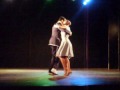
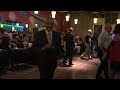
Want to be able to dance confidently and feel comfortable in traditional milongas of Buenos Aires?
Our teaching develops your musicality, connection, technique & improvisation with social tango, as well as insights into tango culture and critical skills to build your confidence with milonga etiquette.


Friday, 18 January 2008

What do women want? What do men want?

I've lost count of the number of times I have heard the following sentiment expressed by men learning to dance tango: "I feel I should dance lots of complex figures at the milonga so that my partner doesn't get bored".

But as a woman in tango, I wish to feel transported by the music and the intimate communication with my partner - whoever that might be at the time. Here's Milena Plebs' take on this topic in Tango íntimo. Just scroll down a little for the English translation.

Happy dancing,
Pat.

Wednesday, 2 January 2008

Chaperones and the milonga

I recently came across an interesting historical perspective (alas, only in Spanish) on the development of some strongly held milonga codes, and it all makes absolute sense. The fact that those codes still serve very useful, but somewhat different functions today has ensured their longevity in the world of tango.

Consider the era - maybe the 30s. A young (unmarried) woman wanted to go dancing. Nice girls could only do so in Buenos Aires when chaperoned by a trusted relative. This naturally implied that any interested, young man would certainly not be permitted to join her at her table. That would have compromised her reputation. So the invitation to dance was made by the clever game of eye contact, or the cabeceo. Today, of course, it remains an unbeatable strategy for selecting dance partners, while avoiding the embarrassment of public rejection.

Ever wondered why couples don't just start dancing as soon as the music begins, and instead spend chunks of valuable dance time chatting before taking up the embrace? I guess if a young man wanted to chat up a tasty, but chaperoned chica, those brief opportunities were all he had to make a lasting impression on her. Nowadays, the social function is still served, but the chat-time also provides the opportunity to feel the music, not to mention waiting for a space to clear in the line of dance.

Why on earth have a cortina, that snippet of non-dance music separating the tandas, when the dance-floor should be cleared? Well, just imagine the gossip resulting from dancing more than one tanda consecutively with the same partner, or a single woman not returning to her own table during the cortina. That señorita's reputation would have been somewhat tarnished, to say the least. In today's traditional milongas in BsAs, this would still signify an existing or budding relationship, but dancing with a range of people is a more social activity anyway, don't you think?

See you on the dance floor,
Pat.

Thursday, 6 December 2007

What is tango?

This is a question guaranteed to generate animated debate. In his blog Miguel Angel Pla quotes the great tango poet Discépolo when he says “it’s a feeling that you can dance”..... there is more thought-provoking stuff in Miguel’s musings.

The subtlety and musicality in the dancing of the older milongueros is being appreciated by many more people, helping them to define their meaning of ‘tango’. Take a look at the links to Pocho & Nellie, & the late Ricardo Vidort y Liz Haight, to see examples of how “less is more”. However, it’s not just the old guard, as Ney Melo & Jennifer Bratt’s Poema illustrates.

Some of the words that come to mind when people talk about tango include, “connection”, “the embrace”, “elegance”, “musicality”, “passion”. Marcela Durán personifies the latter in a stage performance of A Evaristo Carriego with Carlos Gavito.

Feel free to give your opinions by writing a comment to this posting, but just one more thing … consider what Carmencita Calderón might mean to the culture of tango. Firstly, watch her in a 1933 movie with "El Cachafaz", then sit back and absorb the significance of her dancing at her 100 years birthday celebration!

Bob.

Tuesday, 13 November 2007

BsAs milongas from the woman´s perspective

Well here´s my view on how to make the most of the milonga - at least at the milongas where Bob and I choose to go in separately. Some milongas lend themselves to this, whereas others are more suited to couples.

If we were to enter and be seated together at any milonga, there would be a few implications and consequences: we would be seen as a couple, dancing only with each other and therefore usually seated in the area for couples. Eye contact across the dancefloor for the ¨cabeceo¨ is not required here, for obvious reasons, so the location in the milonga does not lend itself to meeting other potential dance partners. In fact to try to use the cabeceo from a couples table would send quite confusing messages to a local milonguero!

So when we choose to attend a milonga separately:
  • We enter, pay and are seated separately in the women´s and men´s areas respectively
  • Soon after, I visit the ladies loo and change into my dance shoes, as it´s considered bad form to change them in the milonga itself. Although I´ve seen people do it, your awareness and respect for the codes of the milonga will be noted by others if you prepare yourself for the milonga in the bathroom. Some women undergo a complete tranformation from their day-to-day persona by the time they enter the milonga
  • I find it´s important to watch the dancers for a while, to take in the mood of the place and importantly, to identify potential dance partners. Contrary to common belief, it´s not just up to the man to select dance partners in the traditional milonga.
  • Yes, that´s right, I am an active participant in choosing a dance partner, but I never approach a man directly and ask him to dance, or vice versa. That would be asking for a public refusal and embarassment for both parties. No, it´s all in the eyes.
  • My cabeceo process starts with appraising potential dance partners in action, showing discreet approval as they dance past, perhaps with a smile. My body language when seated is open and shows I´m interested in dancing. Even if I´m chatting to the lady next to me, it will not be an in-depth conversation, which would close me off from eye contact with the men, unless of course, I´m not interested in dancing that tanda.
  • Bob will ask me to dance early in the piece (via the cabeceo, of course) to show that we are both capable dancers who also respect the milonga conventions, and won´t cause embarassment to other potential partners. This includes using appropriate floorcraft, which does not interfere with other dancers: no ganchos, high boleos, long steps on a crowded floor, etc. At the end of the tanda, he accompanies me back to my table before returning to his.
  • When a new tanda starts and I like the music, I will discreetly scan the room to see if a dance partner of my choosing is available. If our eyes meet and and the nod is exchanged, he will approach my table. At this point, I wait until he is close enough to me to be sure I wasn´t mistaken and the woman next to me was actually the one he wanted to dance with. So I don´t stand up until I´m sure, thus avoiding embarassment all round. I´ve seen some women point to themselves at this point, as if to say¨Did you mean me?¨ But I prefer the wait-and-see approach, so no one is the wiser if there was a misunderstanding.
    This discreet selection give all parties a chance to select partners according to their comfort levels without the embarassment of overt refusals.
  • On the other hand, if I don´t feel like dancing and/or no suitable partners are available, I ensure that my body language indicates I´m not dancing at this stage, eg. by watching the couples on the dance floor, listening to the music, and definitely not seeking out eye-contact with the men seated in their area.
  • Occasionally someone may try to ask for a dance directly, but I tend to politely refuse. Unless I am sure I will be comfortable dancing with him, I would be putting myself in a potentially embarrassing position in front of the milonga, and I would have no-one to blame but myself. And it´s true, everyone sees everything at the milonga.
  • Oh, and I should add that presenting myself well for the milonga is important. It´s no secret that it helps to take time to dress appropriately, etc.
  • On the other hand, when sharing a table with friends, some of these codes are relaxed, for obvious reasons.

Pat.

Thursday, 1 November 2007

Making the most of BsAs milongas

It´s every foreigner´s desire to "dance with the locals", but if you´re a couple, there are some adjustments to make. Here are some tips that worked for me (& therefore, for Pat):
  • we enter the milonga separately, which means that I´ll be seated at a table with other men; I also make a quick trip to the toilet to change my shoes
  • I watch the dancers for a while - maybe 2 tandas - to get the feel of the milonga and to identify potential dance partners
  • it´s been a good idea to dance with Pat early in the milonga, so that others can assess our ability, style, and musicality - important if my use of the cabeceo is to be successful
  • the cabeceo is my only means of inviting women to dance - a direct approach can mean an embarassing refusal! In the larger milongas, I´m able to walk around a bit in order to catch the eye of a woman I wanted to dance with
  • at each milonga, it takes a while to become known, and I simply have to be patient and build up my reputation in order for women to, in reality, invite me to dance via the cabeceo
  • once my invitation had been accepted, it´s time to put into action some more of the codes that Gustavo Benzecry Saba wrote about in his book "La pista del abrazo". I walk around the perimeter of the dance space until I reached my partner - and only then will she stand up. This also means it´s clear to the woman that it is her that I´m approaching, and not someone near her
  • after a brief "hola", my next move is crucial in givng my partner confidence in my ability to dance well with her. The embrace is a complete story in itself - and it´s a defining moment in this tanda for us
  • I´ll take time to absorb the music before my first step; from here, my navigation around the floor is of immense importance. I´m dancing with the other couples around me, and it´s important to protect my partner & my space in the milonga, as well as respect the space of others
  • at the first cortina, my Spanish is barely adequate for a conversation, but it´s good enough to continue the connection begun with the dance .... and at the end of the tanda, accompanying the lady back to her table is an appropriate final touch

Bob

Popular posts